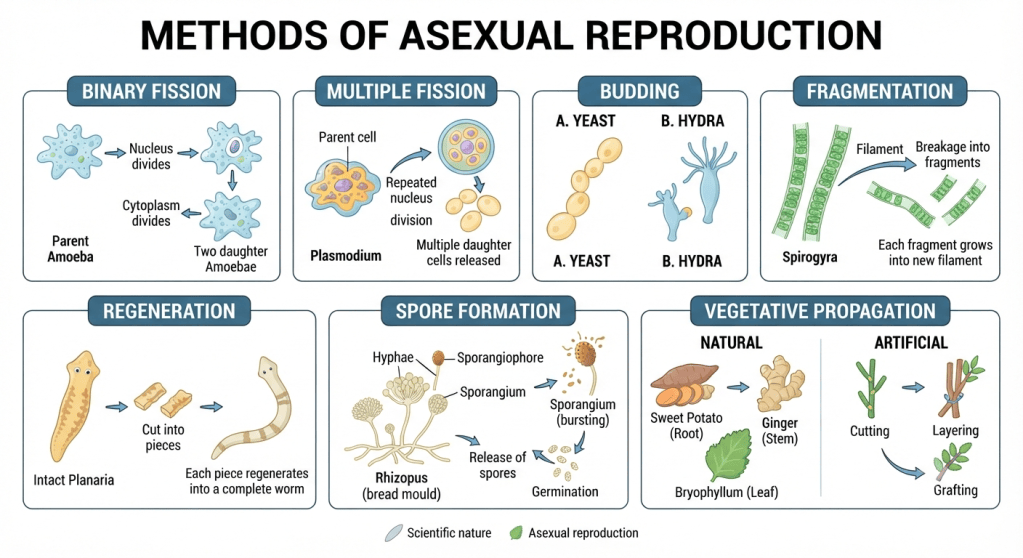
The important methods of asexual reproduction are:
- Binary fission
- Multiple fission
- Budding
- Fragmentation
- Regeneration
- Spore formation
- Vegetative propagation
Let’s understand each method separately.
A. Binary Fission
Binary fission is a type of asexual reproduction in which one parent organism divides into two nearly equal daughter organisms.
Example: Amoeba
Process:
- Amoeba is a unicellular organism.
- First, its nucleus divides into two nuclei.
- Then the cytoplasm divides.
- Finally, two daughter Amoebae are formed.
- Each daughter Amoeba grows into an independent organism.
Other examples: Paramecium and bacteria.
B. Multiple Fission
Multiple fission is a type of asexual reproduction in which one parent organism divides into many daughter cells at the same time.
Example: Plasmodium
Process:
- The nucleus of the parent organism divides repeatedly.
- Many nuclei are formed inside the parent cell.
- The cytoplasm surrounds each nucleus.
- Many daughter cells are produced.
- The parent cell eventually releases these daughter cells.
Example: Plasmodium, the malarial parasite.
C. Budding
Budding is a type of asexual reproduction in which a small outgrowth called a bud develops on the parent organism and eventually separates to form a new individual.
Example: Yeast and Hydra
Budding in Yeast:
- A small bud develops on the parent yeast cell.
- The nucleus divides into two nuclei.
- One nucleus moves into the developing bud.
- The bud grows gradually.
- It separates from the parent cell and develops into a new yeast cell.
Budding in Hydra:
- A small outgrowth develops on the body of Hydra.
- Cells divide repeatedly at that region.
- The bud grows and develops structures such as a mouth and tentacles.
- The fully developed bud separates from the parent.
- It lives independently as a new Hydra.
D. Fragmentation
Fragmentation is a method of asexual reproduction in which the parent organism breaks into two or more fragments, and each fragment develops into a complete organism.
Example: Spirogyra
Process:
- Spirogyra is a filamentous green alga.
- Its filament breaks into smaller pieces or fragments.
- Each fragment grows by repeated cell division.
- Each fragment develops into a complete Spirogyra.
E. Regeneration
Regeneration is the ability of an organism to develop a complete new individual from a body part or fragment under suitable conditions.
Examples: Planaria and Hydra.
For example, when Planaria is cut into several pieces, each suitable fragment can develop into a complete organism.
Remember: Regeneration and fragmentation are not exactly the same. Fragmentation is a method of reproduction in which the parent breaks into fragments, whereas regeneration is the ability to regrow missing parts or develop an entire organism from a fragment.
F. Spore Formation
Spore formation is a type of asexual reproduction in which organisms produce tiny reproductive structures called spores.
Example: Rhizopus (bread mould).
Process:
- Rhizopus produces thread-like structures called hyphae.
- Some hyphae develop into upright structures called sporangiophores.
- A round structure called a sporangium develops at the tip.
- The sporangium contains numerous spores.
- When the sporangium bursts, spores are released.
- Under favourable conditions, spores germinate and develop into new Rhizopus organisms.
Advantages of spores:
- They are produced in large numbers.
- They have protective walls.
- They can survive unfavourable environmental conditions.
- They are easily dispersed by air.
G. Vegetative Propagation
Vegetative propagation is a type of asexual reproduction in plants in which new plants develop from vegetative parts such as roots, stems and leaves instead of seeds.
Vegetative propagation occurs in two ways.
1. Natural vegetative propagation
New plants develop naturally from different plant parts.
| Plant part | Example |
| Root | Sweet potato, Dahlia |
| Stem | Potato, Ginger, Turmeric |
| Leaf | Bryophyllum |
Examples explained:
- Potato: Small buds called eyes are present on the potato tuber. Each eye can develop into a new plant.
- Ginger: The underground stem contains buds that develop into new plants.
- Bryophyllum: Small buds develop along the margins of its leaves. These buds grow into new plants.
2. Artificial vegetative propagation
Humans use different techniques to produce new plants.
Important methods include:
- Cutting: A piece of stem is planted in soil. Example: Rose, Sugarcane.
- Layering: A branch is bent towards the soil and covered with soil. Roots develop from the covered portion. Example: Jasmine.
- Grafting: The stem of one plant is joined to the rooted part of another plant. Example: Mango, Citrus.
Advantages of vegetative propagation:
- New plants can be produced quickly.
- Plants are genetically similar to the parent.
- Plants that do not produce viable seeds can be propagated.
- Desirable characteristics of the parent plant can be maintained.
- Plants generally mature and produce flowers or fruits earlier than seed-grown plants.


Leave a Reply