1. Introduction
In the previous topics, we learnt about the structure and different parts of a cell. We also learnt that all living organisms are made up of cells.
Cells are mainly studied under two categories:
- Plant cells
- Animal cells
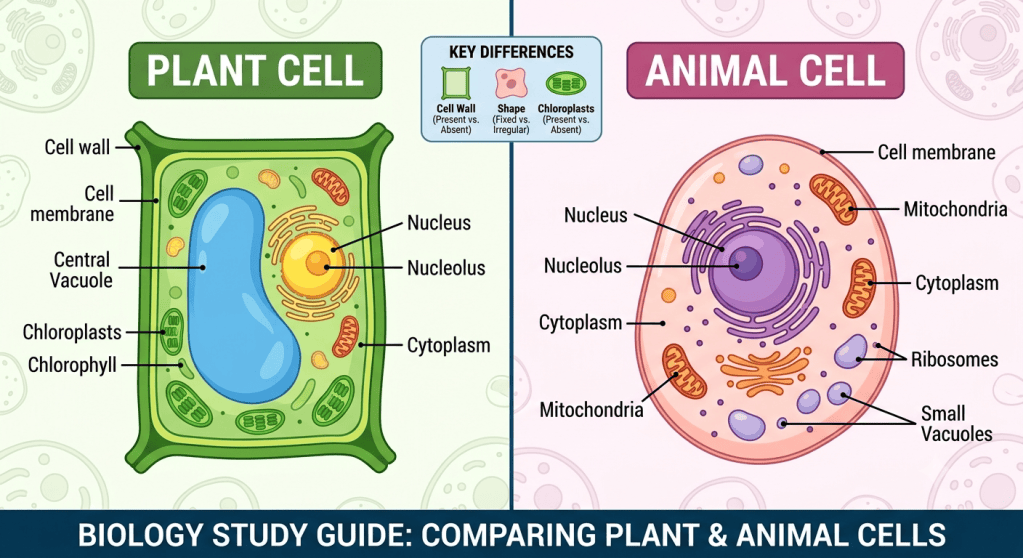
Both plant cells and animal cells have some similarities as well as differences.
In this topic, we will learn how to compare plant cells and animal cells based on their structure and the presence of different cell components.
2. Plant Cell
Definition: A plant cell is the basic structural and functional unit of a plant.
Plant cells are found in different parts of plants, such as roots, stems and leaves.
Important Features of a Plant Cell
- Cell wall: Plant cells have a thick outer covering called the cell wall. It provides protection and support.
- Cell membrane: It is present inside the cell wall and controls the movement of substances into and out of the cell.
- Cytoplasm: It is the jelly-like substance present inside the cell.
- Nucleus: It controls the activities of the cell and contains hereditary material.
- Vacuole: Plant cells generally have a large central vacuole.
- Plastids: Plant cells contain plastids. Some plastids are green in colour and are called chloroplasts.
- Chlorophyll: Chloroplasts contain chlorophyll, which is essential for photosynthesis.
3. Animal Cell
Definition: An animal cell is the basic structural and functional unit of an animal.
Animal cells are found in different parts of the animal body.
Important Features of an Animal Cell
- Cell membrane: Animal cells are surrounded by a cell membrane.
- Cytoplasm: It is the jelly-like substance present inside the cell.
- Nucleus: It controls the activities of the cell and contains hereditary material.
- Vacuoles: Animal cells generally have much smaller vacuoles compared to plant cells.
- Cell wall: Animal cells do not have a cell wall.
- Plastids: Animal cells do not have plastids or chloroplasts.
4. Similarities Between Plant and Animal Cells
Plant cells and animal cells have several common features.
Both plant and animal cells have:
- Cell membrane: Both have a cell membrane that surrounds the cell.
- Cytoplasm: Both contain jelly-like cytoplasm.
- Nucleus: Both generally have a well-organised nucleus surrounded by a nuclear membrane.
- Cell organelles: Both contain different cell organelles that perform specific functions.
- Vacuoles: Both have vacuoles, although their sizes differ.
Plant cells and animal cells are eukaryotic cells because they have a well-organised nucleus surrounded by a nuclear membrane.
5. Differences Between Plant Cells and Animal Cells
The following table shows the important distinguishing features of plant cells and animal cells.
| Feature | Plant cells | Animal cells |
| Cell wall | Present | Absent |
| Cell membrane | Present, inside the cell wall | Present, forms the outer boundary |
| Shape | Usually fixed or regular in shape | Usually irregular or rounded in shape |
| Vacuoles | Generally large | Much smaller |
| Plastids | Present | Absent |
| Chloroplasts | Present in green parts of plants | Absent |
| Chlorophyll | Present in chloroplasts | Absent |
| Nucleus | Present | Present |
Explanation of Important Differences
1. Cell Wall
- Plant cells have a thick cell wall outside the cell membrane.
- Animal cells do not have a cell wall.
- The cell wall provides protection and support to plant cells.
2. Shape
- Plant cells generally have a fixed or regular shape because of the presence of the cell wall.
- Animal cells usually have an irregular or rounded shape because they do not have a cell wall.
3. Vacuoles
- Plant cells generally have one large central vacuole.
- Animal cells have much smaller vacuoles.
4. Plastids
- Plastids are present in plant cells.
- Plastids are absent in animal cells.
- Some plastids contain chlorophyll and are called chloroplasts.
5. Chloroplasts
- Chloroplasts are present in the green parts of plants.
- They contain chlorophyll, which helps in photosynthesis.
- Animal cells do not contain chloroplasts.
6. Points to Remember
- Both plant and animal cells are the basic structural units of their respective organisms.
- Both plant and animal cells have a cell membrane, cytoplasm and nucleus.
- Plant cells have an additional protective covering called the cell wall.
- Animal cells do not have a cell wall.
- Plant cells generally have large vacuoles.
- Animal cells have much smaller vacuoles.
- Plastids are present in plant cells but absent in animal cells.
- Chloroplasts contain chlorophyll.
- Chlorophyll is essential for photosynthesis.


Leave a Reply