1. Introduction
In the previous topic, we learnt that the cell is the basic structural unit of life. All living organisms are made up of cells.
Every cell contains different parts that perform different functions. These parts work together to keep the cell alive and carry out its activities.
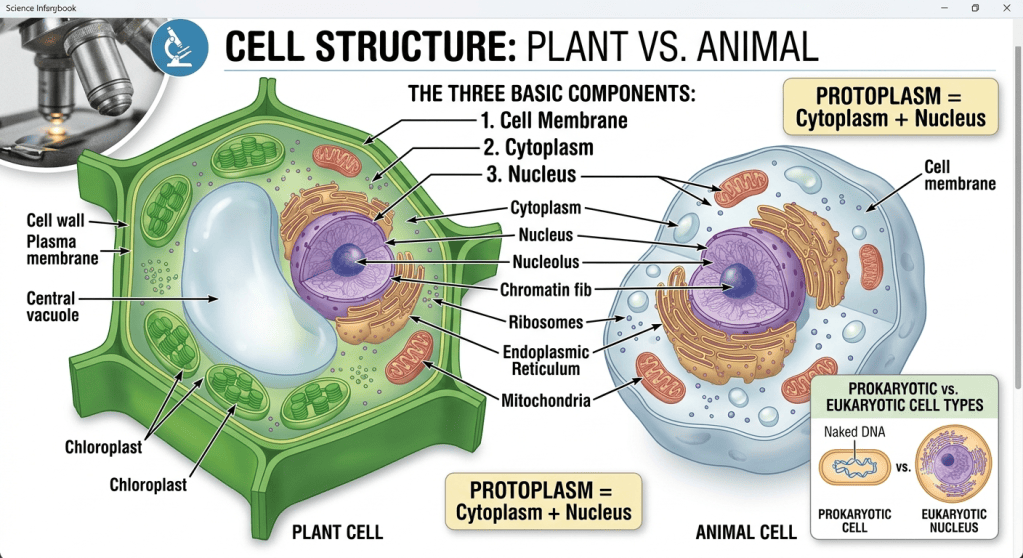
The three basic components of a cell are:
- Cell membrane
- Cytoplasm
- Nucleus
Important: The cytoplasm and nucleus are enclosed within the cell membrane, which is also called the plasma membrane.
Let us understand each part of the cell in detail.
2. Cell Membrane (Plasma Membrane)
Definition: The cell membrane is the thin outer covering of a cell that separates the cell from its surroundings.
It is also known as the plasma membrane.
Structure and Functions of the Cell Membrane
- The cell membrane forms the outer boundary of the cell.
- It separates one cell from another cell.
- It separates the inside of the cell from the surrounding environment.
- It encloses the cytoplasm and nucleus inside the cell.
- It is porous in nature.
- It allows the movement of different substances or materials both inward and outward through it.
- It helps to give shape to the cell.
Think of the cell membrane as a protective boundary around a house. It separates the inside from the outside and allows materials to move in and out.
Cell Membrane in Plant Cells
In plant cells, the cell membrane is covered by an additional thick outer layer called the cell wall.
- The cell membrane is present inside the cell wall.
- The cell wall is a thick outer covering surrounding the cell membrane.
- It provides additional protection to plant cells.
Why Do Plant Cells Need a Cell Wall?
Plants cannot move from one place to another like animals. Therefore, they are directly exposed to different environmental conditions.
Plant cells need extra protection against:
- Variations in temperature.
- High wind speed.
- Changes in atmospheric moisture.
- Other environmental variations.
The cell wall provides additional protection and support to plant cells against these conditions.
Observation of Plant Cells
Plant cells can be observed using the leaf peel of the following plants:
- Tradescantia
- Elodea
- Rhoeo
How can we observe them?
- Take a thin peel of a leaf.
- Prepare a microscope slide, just as we prepare an onion peel slide.
- Observe the slide under a microscope.
The cells can be seen under the microscope.
Animal cells can also be observed under a microscope. For example, cells from the inner lining of our cheek can be collected and observed.
3. Cytoplasm
Definition: Cytoplasm is the jelly-like substance present between the cell membrane and the nucleus.
Structure and Functions of Cytoplasm
- Cytoplasm is a jelly-like substance found inside the cell.
- It is present between the cell membrane and the nucleus.
- It contains various small structures called cell organelles.
- These organelles perform different functions necessary for the proper working of the cell.
Important Cell Organelles Present in Cytoplasm
Some of the cell organelles present in the cytoplasm are:
| Cell organelle | Basic function |
| Mitochondria | Help in releasing energy from food |
| Golgi bodies | Help in packaging and transporting materials |
| Ribosomes | Help in protein synthesis |
Note: These organelles are mentioned here as examples from the textbook. Their detailed structure and functions are studied in later classes.
Cytoplasm is the jelly-like substance that contains different cell organelles.
4. Nucleus
Definition: The nucleus is an important component of a living cell that controls the activities of the cell and contains hereditary material.
Structure of the Nucleus
- The nucleus is generally spherical in shape.
- It is usually located in the centre of the cell.
- It can be stained and observed easily with the help of a microscope.
- The nucleus is separated from the cytoplasm by a covering called the nuclear membrane.
- The nuclear membrane is porous in nature.
- It allows the movement of materials between the cytoplasm and the inside of the nucleus.
Parts Present Inside the Nucleus
When we observe the nucleus using a microscope with higher magnification, we can see the following structures:
A. Nucleolus
- It is a smaller spherical body present inside the nucleus.
- It can be observed using a microscope with higher magnification.
B. Chromosomes
- The nucleus contains thread-like structures called chromosomes.
- Chromosomes carry genes.
- Genes help in the inheritance or transfer of characteristics from parents to offspring.
- Chromosomes can be clearly seen only when the cell divides.
Functions of the Nucleus
- It acts as the control centre of the activities of the cell.
- It contains chromosomes.
- Chromosomes carry genes.
- Genes control the transfer of hereditary characteristics from parents to offspring.
Easy understanding: The nucleus is like the control room of a cell because it controls the different activities taking place inside the cell.
5. Gene
Definition: A gene is a unit of inheritance in living organisms.
Genes control the transfer of hereditary characteristics from parents to their offspring.
What is Inheritance?
Inheritance is the process by which characteristics or features are passed from parents to their children.
For example:
- If your father has brown eyes, you may also have brown eyes.
- If your mother has curly hair, you may also have curly hair.
These characteristics are transferred from parents to children through genes.
Important Points About Genes
- Genes are present on chromosomes.
- Chromosomes are found inside the nucleus.
- Genes are responsible for transferring hereditary characteristics.
- Children inherit characteristics from both their parents.
- Different combinations of genes inherited from parents result in different characteristics among children.
Example to understand:
Suppose a child inherits genes from both parents. The combination of these genes helps determine characteristics such as eye colour, hair type and other inherited features.
Remember this sequence:
Cell → Nucleus → Chromosomes → Genes → Hereditary characteristics
6. Nucleus as the Control Centre of the Cell
Apart from helping in inheritance, the nucleus performs another important function.
- It acts as the control centre of the activities of the cell.
- It controls and coordinates different activities taking place inside the cell.
- It contains chromosomes, which carry genes responsible for inheritance.
Therefore, the nucleus is an important component of the cell because it is involved in both cell control and inheritance.
7. Protoplasm
Definition: The entire content of a living cell is known as protoplasm.
Protoplasm includes two main components:
- Cytoplasm
- Nucleus
PROTOPLASM (Living substance of the cell)
Cytoplasm Nucleus
Control centre of the cell Jelly-like substance
Important Points
- Protoplasm is the living substance of the cell.
- It includes the cytoplasm and nucleus.
- The cell membrane surrounds the protoplasm.
Remember:
Protoplasm = Cytoplasm + Nucleus
8. Types of Cells Based on the Structure of the Nucleus
All cells do not have the same type of nucleus.
Based on the organisation of their nuclear material, cells are divided into two types:
- Prokaryotic cells
- Eukaryotic cells
Let us understand them in detail.
A. Prokaryotic Cells
Definition: Cells that have nuclear material without a nuclear membrane are called prokaryotic cells.
The nucleus in these cells is not well-organised like the nucleus in the cells of multicellular organisms.
Characteristics of Prokaryotic Cells
- The nuclear material is not surrounded by a nuclear membrane.
- They do not have a well-organised nucleus.
- Their nuclear material is present in the cytoplasm without a nuclear membrane.
- These cells are found in organisms called prokaryotes.
Examples
- Bacteria
- Blue-green algae (cyanobacteria)
Meaning of the Word Prokaryote
The word prokaryote is made up of two parts:
- Pro = Primitive
- Karyon = Nucleus
Therefore, prokaryote means primitive nucleus.
B. Eukaryotic Cells
Definition: Cells that have a well-organised nucleus surrounded by a nuclear membrane are called eukaryotic cells.
Characteristics of Eukaryotic Cells
- They have a well-organised nucleus.
- The nucleus is surrounded by a nuclear membrane.
- The nuclear membrane separates the nucleus from the cytoplasm.
- These cells are found in organisms called eukaryotes.
Examples
- Onion cells
- Cheek cells
- All organisms other than bacteria and blue-green algae are called eukaryotes.
Meaning of the Word Eukaryote
The word eukaryote is made up of two parts:
- Eu = True
- Karyon = Nucleus
Therefore, eukaryote means true nucleus.
Difference Between Prokaryotic and Eukaryotic Cells
| Feature | Prokaryotic cells | Eukaryotic cells |
| Nucleus | Not well-organised | Well-organised |
| Nuclear membrane | Absent | Present |
| Nuclear material | Not enclosed by nuclear membrane | Enclosed by nuclear membrane |
| Examples | Bacteria and blue-green algae | Onion cells and cheek cells |
One-line difference:
- Prokaryotic cells: Nuclear material is not surrounded by a nuclear membrane.
- Eukaryotic cells: A well-organised nucleus is surrounded by a nuclear membrane.
9. Vacuoles
While observing onion cells under a microscope, you may notice some blank-looking structures in the cytoplasm.
These structures are called vacuoles.
Definition: Vacuoles are structures present in the cytoplasm that appear as blank or empty spaces when observed under a microscope.
Characteristics of Vacuoles
- Vacuoles are present in the cytoplasm.
- They may appear like blank spaces under a microscope.
- In onion cells, the vacuole may be single and large.
- Cheek cells have smaller vacuoles.
- Large vacuoles are commonly found in plant cells.
- Vacuoles in animal cells are much smaller compared to those in plant cells.
Difference Between Vacuoles in Plant and Animal Cells
| Plant cells | Animal cells |
| Usually have large vacuoles. | Have much smaller vacuoles. |
| Onion cells may have a single large vacuole. | Cheek cells have smaller vacuoles. |
Plant cells generally have large vacuoles, whereas animal cells have smaller vacuoles.
10. Plastids
While observing the cells of a Tradescantia leaf under a microscope, you may notice several small coloured bodies scattered throughout the cytoplasm.
These coloured bodies are called plastids.
Definition: Plastids are small structures present in the cytoplasm of plant cells. They may be of different colours.
Characteristics of Plastids
- Plastids are present in the cytoplasm.
- They can be observed in the cells of Tradescantia leaves.
- They appear as small coloured bodies.
- They are scattered throughout the cytoplasm of leaf cells.
- Plastids are of different colours.
- Some plastids contain a green pigment called chlorophyll.
Types of Plastids Based on Colour
Plastids can be of different colours. One important type mentioned in the textbook is the green-coloured plastid.
Chloroplasts
Definition: Green-coloured plastids containing the green pigment chlorophyll are called chloroplasts.
Important Characteristics of Chloroplasts
- Chloroplasts are green-coloured plastids.
- They contain a green pigment called chlorophyll.
- Chlorophyll is responsible for giving the green colour to leaves.
- Chlorophyll is essential for photosynthesis.
- Chloroplasts present in the leaves help in the process of photosynthesis.
What is Chlorophyll?
Chlorophyll is a green pigment present in chloroplasts.
It is responsible for the green colour of leaves and is essential for photosynthesis.
What is Photosynthesis?
Photosynthesis is the process by which green plants prepare their own food using sunlight, water and carbon dioxide in the presence of chlorophyll.
Remember this relationship:
Plastids
Green plastids – Chloroplasts
Contain chlorophyll
Essential for photosynthesis
11. Important Differences – Quick Comparison
| Cell component | Description |
| Cell membrane | Thin boundary surrounding the cell |
| Cell wall | Thick outer covering present in plant cells |
| Cytoplasm | Jelly-like substance between cell membrane and nucleus |
| Nucleus | Controls cell activities and contains chromosomes |
| Nucleolus | Small spherical body inside the nucleus |
| Chromosomes | Thread-like structures carrying genes |
| Genes | Units of inheritance |
| Vacuoles | Blank-looking structures in the cytoplasm |
| Plastids | Coloured bodies present in plant cell cytoplasm |
| Chloroplasts | Green plastids containing chlorophyll |


Leave a Reply