1. Introduction
All living organisms are made up of different parts called organs. Each organ performs a particular function that helps the organism survive.
- In animals, different organs work together to form an organ system.
- In plants, different organs perform different specialised functions.
- Every organ is made up of smaller parts called tissues.
- Each tissue is made up of a group of similar cells.
2. Organisation of Living Organisms
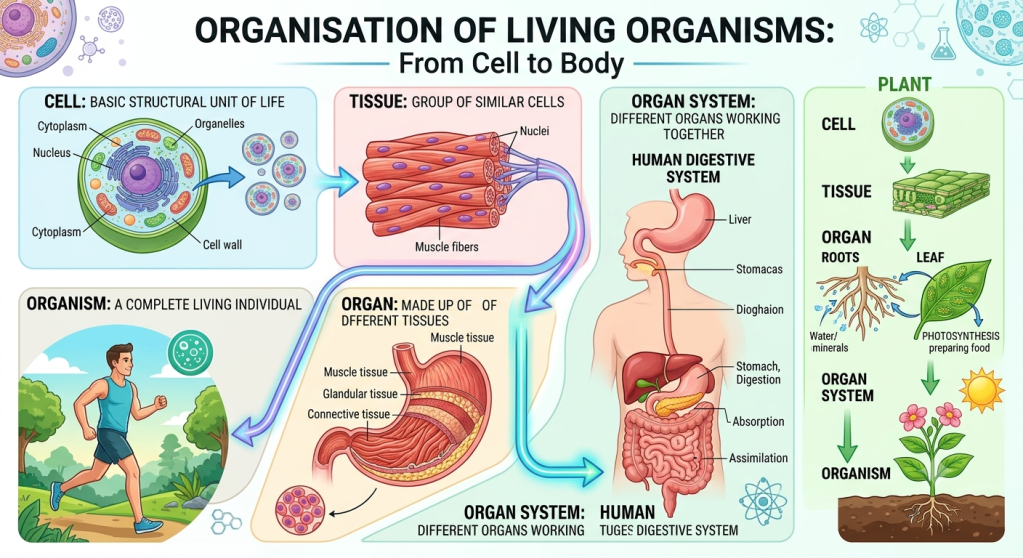
The body of a living organism is organised into different levels, starting from the smallest unit.
Cell (Basic structural unit of life)
↓
Tissue (Group of similar cells)
↓
Organ (Made up of different tissues)
↓
Organ System (Different organs working together)
↓
Organism (A complete living individual)
Cells form tissues, tissues form organs, and organs work together to form organ systems.
3. Organs and Their Functions
Different organs perform different functions in living organisms.
A. Organs in Animals
For example, the digestive system consists of different digestive organs.
Each organ performs a specific function:
- Digestion: Breaking down complex food into simpler substances.
- Absorption: Taking digested nutrients into the blood.
- Assimilation: Using the absorbed nutrients for growth, energy and repair.
All these functions are performed by different organs of the digestive system working together.
B. Organs in Plants
Different plant organs also perform specialised functions.
Examples:
- Roots: Help in the absorption of water and minerals from the soil.
- Leaves: Prepare or synthesise food for the plant through photosynthesis.
4. What is a Tissue?
Definition:
A tissue is a group of similar cells that work together to perform a specific function.
- Tissues are made up of cells.
- Similar cells combine to form tissues.
- Each tissue performs a particular function.
- Different tissues combine to form organs.
Example: An organ is made up of tissues, and tissues are made up of cells.
6. Concept to Understand
- An organ is made up of tissues.
- Tissues are made up of cells.
- Therefore, cells form the basic building blocks of all living organisms.
This means that the cell is the basic structural unit of life.
Important Points
- Each living organism has different organs.
- Different organs perform different functions.
- The digestive system consists of different digestive organs.
- Digestion, absorption and assimilation are important functions of the digestive system.
- Roots absorb water and minerals from the soil.
- Leaves synthesise food for plants.
- Each organ is made up of smaller parts called tissues.
- A tissue is a group of similar cells performing a specific function.
- An organ is made up of tissues.
- Tissues are made up of cells.
- The cell is the basic structural unit of a living organism.


Leave a Reply