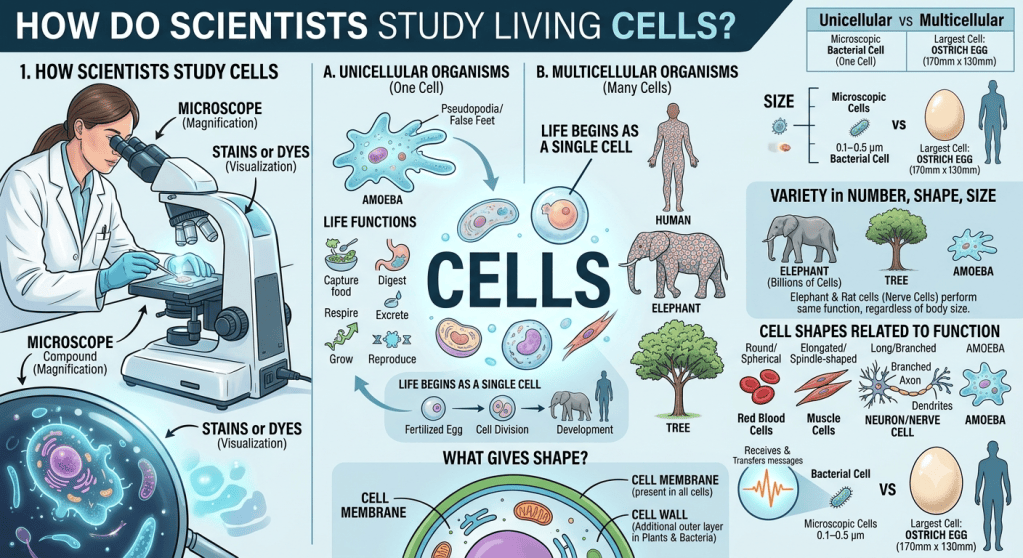
. How Do Scientists Study Living Cells?
Cells are very small, so most of them cannot be seen with our naked eyes.
Scientists use a microscope to observe and study cells.
Microscope
A microscope is an instrument that magnifies very small objects, making them appear larger so that we can observe them.
Stains or Dyes
Cells contain many tiny parts that may be difficult to see clearly.
Scientists use stains (dyes) to give colour to different parts of a cell.
This helps them:
- See the cell more clearly.
- Identify different parts of the cell.
- Study the detailed structure of the cell.
2. Variety in Living Organisms
There are millions of living organisms on Earth.
They differ from one another in:
- Shape
- Size
- Number of cells
- Structure and functions of their organs
For example:
- A tiny organism may consist of only one cell.
- A huge animal like an elephant has billions or trillions of cells.
- A tall tree also contains a very large number of cells.
So, organisms show a great variety in cell number, shape and size.
3. Number of Cells
Have you ever wondered how many cells are present in the human body, a tall tree, or an elephant?
The number can be extremely large—billions or even trillions.
Remember:
1 billion = 1,000 million
1 trillion = 1,000 billion
The human body contains trillions of cells.
These cells are not all the same. They differ in:
- Shape
- Size
- Structure
- Function
Different groups of cells perform different functions in our body.
4. Types of Organisms Based on Number of Cells
Organisms can be divided into two main groups based on the number of cells they have:
A. Unicellular organisms
B. Multicellular organisms
Let’s understand them.
A. Unicellular Organisms
The word unicellular comes from:
- Uni = one
- Cellular = cell
Therefore,
Unicellular organisms are organisms made up of only one cell.
Example:
Amoeba
Although an amoeba consists of only one cell, that single cell performs all the activities necessary for its survival.
Amoeba can:
- Capture food
- Digest food
- Respire
- Excrete wastes
- Grow
- Reproduce
Therefore, one cell is enough for an amoeba to live independently.
Important Point
A unicellular organism is a complete organism, even though it has only one cell.
B. Multicellular Organisms
The word multicellular comes from:
- Multi = many
- Cellular = cell
Therefore,
Multicellular organisms are organisms made up of more than one cell.
Examples:
- Human beings
- Elephants
- Trees
- Dogs
- Cats
Multicellular organisms contain many cells, and different groups of cells perform different functions.
5. Unicellular vs Multicellular Organisms
| Unicellular | Multicellular |
| Made up of one cell | Made up of many cells |
| Example: Amoeba | Example: Human, elephant, tree |
| One cell performs all life processes | Different groups of cells perform different functions |
| Usually simple in organisation | Usually more complex in organisation |
Easy Way to Remember
UNI = ONE
MULTI = MANY
So:
Unicellular → One cell
Multicellular → Many cells
6. How Does a Multicellular Organism Begin Life?
Here is a very interesting fact!
An organism such as a human being may eventually contain trillions of cells, but it does not begin life with trillions of cells.
It begins as one single cell.
This single cell is called the fertilised egg.
Development:
Fertilised egg → Cell division → More cells → Growth and development → Multicellular organism
As the organism develops:
- The fertilised egg multiplies.
- The number of cells increases.
- Different cells become specialised for different functions.
Therefore, even an organism with billions or trillions of cells begins its life as a single cell.
7. Do Smaller Organisms Function Less Efficiently?
Not necessarily.
Smaller organisms may have fewer cells, but this does not affect their ability to perform necessary life functions.
For example, an amoeba has only one cell, but that cell can perform all the essential activities required for life.
So:
The number of cells does not decide whether an organism can perform its life functions successfully.
8. Division of Work in Multicellular Organisms
In multicellular organisms, different cells perform different jobs.
For example, in humans:
- Blood cells have specific functions.
- Muscle cells help in movement.
- Nerve cells help in receiving and transferring messages.
Groups of specialised cells form tissues.
Different tissues combine to form organs.
Simple flowchart:
Cells → Tissues → Organs → Organ systems → Organism
This is called division of labour because different cells and tissues perform different functions.
9. Shape of Cells
Do all cells have the same shape?
No!
Cells have different shapes, depending mainly on the functions they perform.
Some cells are:
- Round
- Spherical
- Elongated
- Spindle-shaped
- Long
- Branched
- Irregular
10. Shape of Amoeba
Amoeba is a unicellular organism.
It has no definite shape.
Its shape appears irregular because it continuously changes its shape.
Amoeba has temporary projections coming out from its body.
These projections are called pseudopodia.
Pseudopodia
The word pseudopodia means:
- Pseudo = false
- Podia = feet
So, pseudopodia means “false feet.”
They:
- Help amoeba move.
- Help amoeba capture food.
- Appear and disappear.
- May have different lengths.
Therefore, amoeba keeps changing its shape as it moves or feeds.
Remember:
Amoeba → No definite shape → Pseudopodia → Movement and feeding
11. White Blood Cells Can Also Change Shape
A white blood cell (WBC) in human blood is another example of a cell that can change its shape.
However, there is an important difference:
Amoeba
- It is a single cell.
- It is a complete organism.
- It can live independently.
White Blood Cell
- It is a cell of the human body.
- It is not an independent organism.
- It performs its specific function as part of the human body.
12. Different Cells Have Different Shapes
In multicellular organisms such as humans, different types of cells have different shapes.
Examples include:
Blood cells
They have shapes suited to their functions.
Muscle cells
They are generally elongated and help in movement.
Nerve cells
They are usually long and branched.
The different shapes of cells are related to their specific functions.
Important Rule:
The shape of a cell is usually related to the function it performs.
13. Common Shapes of Cells
Cells can have many different shapes.
1. Round or spherical cells
Some cells are approximately round or spherical.
2. Elongated cells
Some cells are longer than they are wide.
3. Spindle-shaped cells
Some cells are:
- Long
- Broad in the middle
- Pointed at both ends
Such cells are called spindle-shaped cells.
4. Branched cells
Some cells have branches.
A good example is the nerve cell or neuron.
14. Nerve Cell or Neuron
A nerve cell is also called a neuron.
It is usually long and branched.
Function of a nerve cell:
The nerve cell:
- Receives messages.
- Transfers messages.
- Helps control different parts of the body.
- Helps coordinate the working of different parts of the body.
Easy memory:
Neuron → Receives + Transfers messages → Control + Coordination
15. What Gives Shape to a Cell?
You may wonder:
What gives a cell its shape?
The components of a cell are enclosed by a cell membrane.
Cell Membrane
The cell membrane:
- Encloses the cell.
- Separates the cell from its surroundings.
- Helps provide shape to plant and animal cells.
Therefore:
The cell membrane helps provide shape to plant and animal cells.
16. Cell Wall in Plant Cells
Plant cells have an additional covering outside the cell membrane.
This covering is called the cell wall.
Cell wall:
- Is present outside the cell membrane.
- Gives shape to plant cells.
- Provides rigidity and strength.
Bacterial cells
Bacterial cells also have a cell wall.
Easy comparison:
Plant cell: Cell membrane + Cell wall
Animal cell: Cell membrane, but no cell wall
Bacterial cell: Cell wall present
17. Size of Cells
Just as cells have different shapes, they also have different sizes.
The size of cells can vary greatly.
Some cells may be as small as:
One-millionth of a metre
This unit is called a micrometre or micron.
It is written as:
1 micrometre = 1 μm
Some cells can be as large as a few centimetres.
18. Most Cells Are Microscopic
Most cells are microscopic.
Microscopic means:
Too small to be seen clearly with the unaided eye.
Therefore, we need a microscope to observe most cells.
Remember:
Microscopic → Cannot normally be seen with naked eyes → Microscope needed
19. Smallest Cell
The smallest cells mentioned in the chapter are found in bacteria.
Their size is approximately:
0.1 to 0.5 micrometre (μm)
So, bacterial cells can be extremely tiny.
20. Largest Cell
The egg of an ostrich is considered the largest single cell mentioned in the chapter.
Its size is approximately:
170 mm × 130 mm
That is much larger than most other cells.
Remember:
Smallest → Bacterial cell → 0.1–0.5 μm
Largest → Ostrich egg → 170 mm × 130 mm
21. Does the Size of an Animal Decide the Size of Its Cells?
No!
This is a very important concept.
The size of a cell is not related to the size of the animal or plant’s body.
For example:
An elephant is much larger than a rat.
But this does not mean that the cells of an elephant must be bigger than the cells of a rat.
22. Elephant and Rat Example
Consider the nerve cells of an elephant and a rat.
Even though an elephant is much larger than a rat:
- Their nerve cells can both be long and branched.
- Their nerve cells perform the same function.
- Both transfer messages.
Therefore:
The size of an organism does not determine the size of its cells.
Instead,
The size and shape of a cell are mainly related to the function it performs.
Most Important Concepts to Remember
1. Microscope
An instrument used to magnify and observe cells.
2. Stains/Dyes
Used to colour parts of cells so that their structures can be studied clearly.
3. Unicellular organism
An organism made up of one cell.
Example: Amoeba
4. Multicellular organism
An organism made up of many cells.
Examples: Human, elephant, tree
5. Pseudopodia
Temporary projections in amoeba that help in movement and feeding.
Pseudo = false; podia = feet
6. Neuron
A nerve cell that receives and transfers messages and helps in coordination.
7. Cell membrane
A covering around the cell that helps provide shape to plant and animal cells.
8. Cell wall
An additional covering present in plant cells and bacterial cells. It provides shape and rigidity.
9. Micrometre
A very small unit used to measure cells.
1 micrometre = 1 μm
10. Smallest cell
Bacterial cell: 0.1–0.5 μm
11. Largest cell
Ostrich egg: 170 mm × 130 mm
Quick Revision Table
| Feature | Important Point |
| Study of cells | Microscope is used |
| Stains | Help colour cell parts |
| 1 billion | 1,000 million |
| 1 trillion | 1,000 billion |
| Unicellular | Made of one cell |
| Example | Amoeba |
| Multicellular | Made of many cells |
| Examples | Human, elephant, tree |
| Beginning of multicellular organism | Fertilised egg |
| Amoeba’s shape | Irregular and constantly changing |
| Pseudopodia | False feet; help in movement and feeding |
| WBC | Can change its shape |
| Neuron | Long and branched |
| Neuron function | Receives and transfers messages |
| Cell membrane | Helps provide shape |
| Cell wall | Gives shape and rigidity |
| Cell wall found in | Plant and bacterial cells |
| Most cells | Microscopic |
| Smallest bacterial cells | 0.1–0.5 μm |
| Largest cell | Ostrich egg |
| Ostrich egg size | 170 mm × 130 mm |
| Cell size and body size | Not directly related |
| Cell size and shape | Related to its function |


Leave a Reply