What is the Discovery of the Cell?
The discovery of the cell was an important event in the study of living organisms. It helped scientists understand that living organisms are made up of tiny structures called cells.
Robert Hooke and the Discovery of the Cell
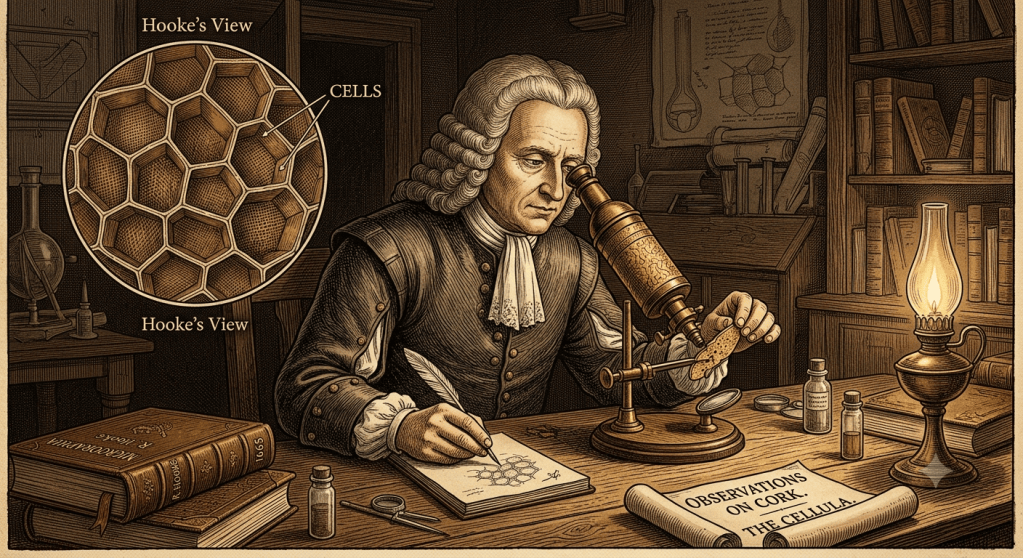
- In 1665, a scientist named Robert Hooke observed a thin slice of cork.
- Cork is a part of the bark of a tree.
- Hooke used a simple magnifying device (microscope) to observe the cork.
- He took very thin slices of cork and observed them under the microscope.
What did Robert Hooke see?
When Hooke observed the cork under the microscope, he noticed:
- Many small boxes or compartments.
- These compartments were arranged closely together.
- They looked like the small compartments of a honeycomb.
- Each compartment was separated from the next one by a wall or partition.
Because these compartments looked like small rooms or boxes, Hooke called each one a “cell.”
Important Point
The word “cell” was given by Robert Hooke in 1665.
What were the cells observed by Hooke?
The boxes that Robert Hooke observed in the cork were not living cells.
They were actually dead cells.
This is because the cork is made up of cells that are dead and have empty spaces inside them.
Remember:
Robert Hooke → Cork → 1665 → Box-like compartments → Called them “Cells” → Dead cells
Observation of Living Cells
At the time of Robert Hooke, microscopes were not very powerful.
Therefore, scientists could not clearly observe the cells of living organisms.
The cells of living organisms could be observed only after the development of improved microscopes.
Improved microscopes helped scientists to:
- See cells more clearly.
- Observe the structure of cells.
- Study living cells.
- Understand the different parts and functions of cells.
What happened after Hooke’s discovery?
After Robert Hooke’s observation, very little was known about cells for nearly 150 years.
This was mainly because the microscopes available at that time were not powerful enough to study cells in detail.
Later, as microscopes became better and their magnification increased, scientists were able to learn much more about cells.
Role of Improved Microscopes
Today, we know a great deal about:
- Cell structure
- Different parts of the cell
- Functions of cells
- How cells work in living organisms
This knowledge has become possible mainly because of the development of improved microscopes with high magnification.
What is Magnification?
Magnification means making a very small object appear larger so that it can be observed clearly.
For example, a cell is extremely small and cannot normally be seen with our naked eyes. A microscope magnifies the cell and allows us to study it.
Revision
| Point | Information |
| Scientist | Robert Hooke |
| Year | 1665 |
| Material observed | Cork |
| Cork is a part of | Bark of a tree |
| Instrument used | Simple magnifying device/microscope |
| What he observed | Box-like compartments |
| Appearance | Like a honeycomb |
| Compartments separated by | Walls/partitions |
| Name given | Cell |
| Cells observed by Hooke | Dead cells |
| Living cells observed later because of | Improved microscopes |
| For about 150 years | Very little was known about cells |
| Modern knowledge of cells is possible because of | High-magnification improved microscopes |
Flow Chart
Robert Hooke
↓
1665
↓
Thin slice of cork
↓
Observed under a simple microscope
↓
Saw box-like compartments
↓
Compartments looked like a honeycomb
↓
Each compartment separated by a wall
↓
Called each compartment a “Cell”
↓
The cells were actually dead cells
↓
Improved microscopes were developed
↓
Living cells could be observed
↓
Scientists learned more about cell structure and functions
Points to Remember
- Robert Hooke discovered and named the cell in 1665.
- He observed a thin slice of cork under a simple microscope.
- Cork is a part of the bark of a tree.
- Hooke saw box-like compartments in the cork.
- These compartments looked like a honeycomb.
- Each compartment was separated by a wall or partition.
- Hooke called each compartment a “cell.”
- The structures Hooke observed were actually dead cells.
- Living cells could be observed only after improved microscopes were developed.
- For about 150 years after Hooke’s observation, very little was known about cells.
- Today, we know much more about cell structure and functions because of high-magnification microscopes.


Leave a Reply