Introduction to Heredity
What is Heredity?
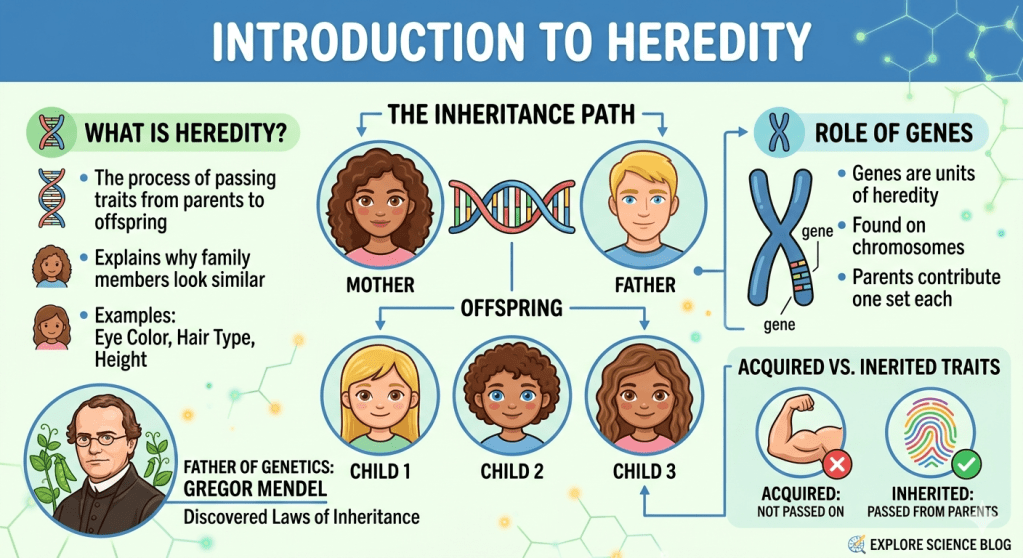
Heredity is the process by which traits or characteristics are passed from parents to their offspring. These traits can include eye color, height, skin tone, hair type, blood group, and even some diseases.
In simple words:
Heredity explains why children look similar to their parents.
Why is Heredity Important?
Heredity helps us to:
- Understand similarities and differences among individuals
- Know how traits are inherited across generations
- Study genetic diseases
- Improve crops and animals through breeding
- Understand evolution
What are Traits?
A trait is any observable feature of an organism.
Examples of traits:
- Eye color
- Hair texture
- Height
- Shape of nose
- Blood group
Traits can be:
- Inherited traits – passed from parents (e.g., eye color)
- Acquired traits – developed during life (e.g., muscles from exercise)
Acquired traits are not inherited.
Role of Genes in Heredity
Traits are controlled by genes.
- Genes are small units of heredity.
- They are found on chromosomes.
- Chromosomes are present in the nucleus of cells.
- Humans have 23 pairs of chromosomes (46 total).
Each parent gives one set of genes to the child.
This is why offspring show features of both mother and father.
Father of Genetics
Gregor Mendel is called the Father of Genetics.
He studied heredity using pea plants and discovered basic laws of inheritance, such as:
- Law of Dominance
- Law of Segregation
- Law of Independent Assortment
His work forms the foundation of modern genetics.
Variation in Heredity
Even within the same family, children are not exactly alike. These differences are called variations.
Variation occurs due to:
- Mixing of genes from parents
- Environmental effects
- Mutations
Variation helps living organisms adapt and survive.
Simple Definition
Heredity is the transmission of genetic characters from parents to offspring through genes.


Leave a Reply