What is a Food Chain?
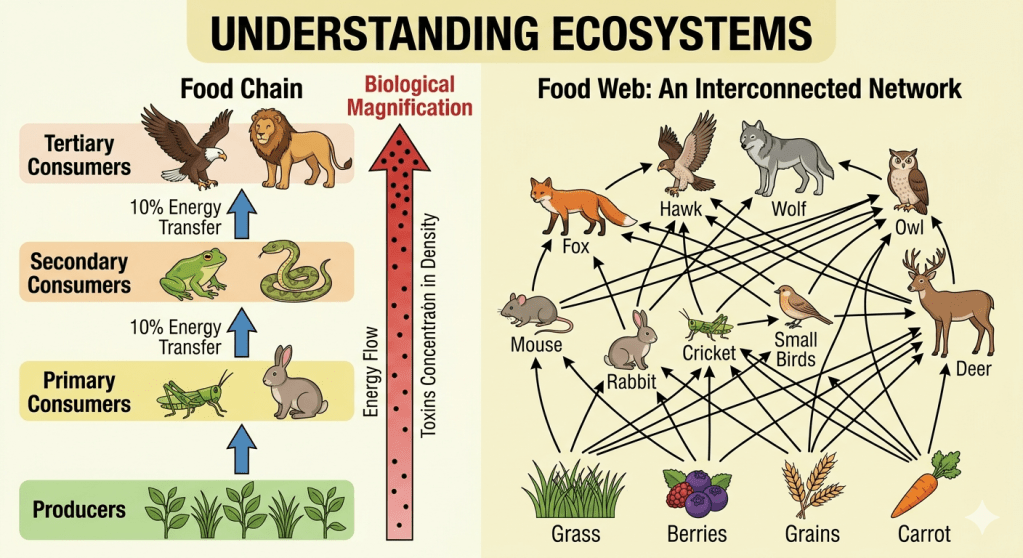
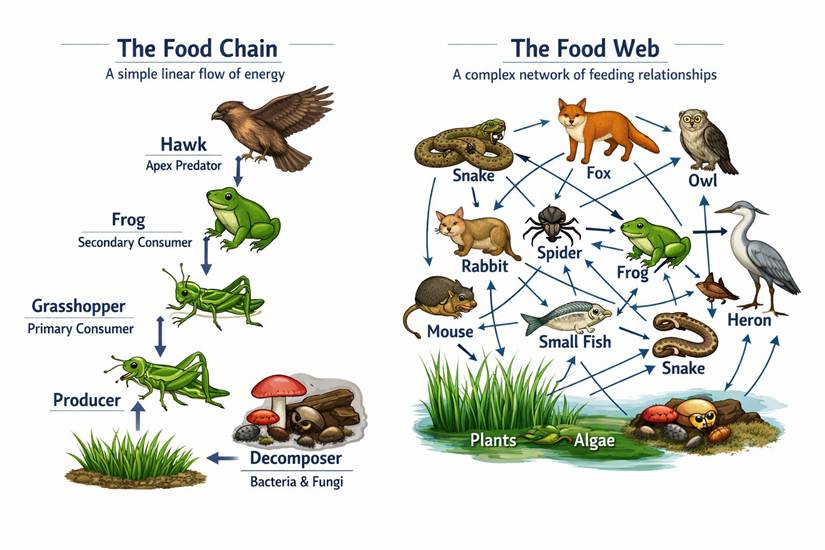
A food chain is a sequence of organisms in which one organism eats another to obtain energy. Each organism occupies a specific level, called a trophic level.
Trophic Levels in a Food Chain
Each step in a food chain is called a trophic level.
Flow Chart: Trophic Levels
Sun
↓
Producers (1st trophic level)
↓
Herbivores / Primary Consumers (2nd level)
↓
Small Carnivores / Secondary Consumers (3rd level)
↓
Large Carnivores / Tertiary Consumers (4th level)
Explanation of Trophic Levels
- Producers (Autotrophs)
- Green plants and algae
- Make their own food using sunlight (photosynthesis)
- Capture solar energy and convert it into food energy
- Primary Consumers (Herbivores)
- Eat plants
- Example: deer, cow, goat
- Secondary Consumers (Small Carnivores)
- Eat herbivores
- Example: frog, lizard
- Tertiary Consumers (Large Carnivores)
- Eat smaller carnivores
- Example: snake, eagle, lion
Flow of Energy in a Food Chain
- Food provides energy to organisms
- Energy flows from one trophic level to the next
- Energy flow is one-way (unidirectional)
Sun → Plants → Animals → Decomposers
Energy Loss in a Food Chain (10% Law)
- Plants capture only about 1% of sunlight energy
- When one organism eats another:
- Most energy is lost as heat
- Some energy is used for movement, digestion, growth
- Only 10% of energy is passed to the next trophic level
Example
Plants (100 units of energy)
↓
Herbivores (10 units)
↓
Carnivores (1 unit)
↓
Top Carnivores (0.1 unit)
Because energy decreases at each level, food chains are usually short (3–4 levels).
Why Are Producers More in Number?
- Maximum energy is available at the producer level
- Energy decreases at higher levels
- Therefore:
- More producers
- Fewer herbivores
- Very few carnivores
What is a Food Web?
In nature, organisms do not depend on only one food source.
A food web is a network of interconnected food chains.
Grass → Deer → Lion
↓ ↑
Insect → Frog → Snake
Food webs make ecosystems more stable.
Important Features of Energy Flow
- Energy flow is one-directional
- Energy does not return to the previous trophic level
- Energy decreases at each level
Biological Magnification
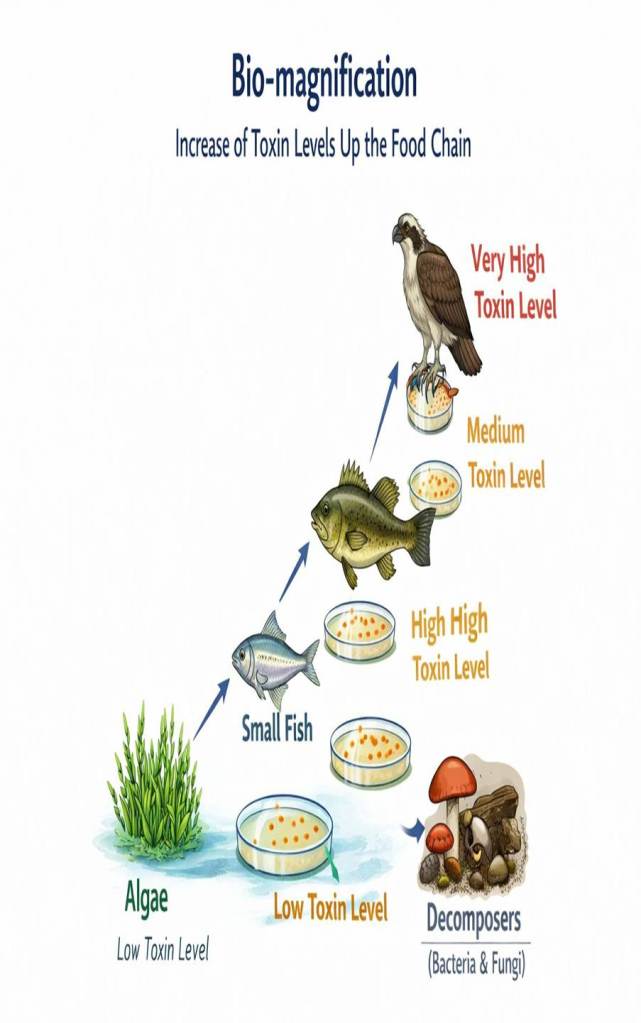
What is Biological Magnification?
The gradual increase in the concentration of harmful chemicals at higher trophic levels of a food chain is called biological magnification.
How Does It Happen?
- Pesticides and chemicals are used in farming
- They enter soil and water
- Plants absorb them
- Animals eat the plants
- Chemicals accumulate because they are non-degradable
Water/Soil
↓
Plants
↓
Herbivores
↓
Carnivores
↓
Humans (maximum concentration)
Why Are Humans Most Affected?
- Humans are at the top trophic level
- Highest amount of harmful chemicals get stored in our bodies
- Washing food cannot always remove these chemicals
Key Points to Remember
- Food chain shows who eats whom
- Each step is a trophic level
- Only 10% energy is transferred to the next level
- Food chains are short
- Food web is a group of food chains
- Biological magnification increases toxins in higher levels
 The Bio Brief
Leave a comment