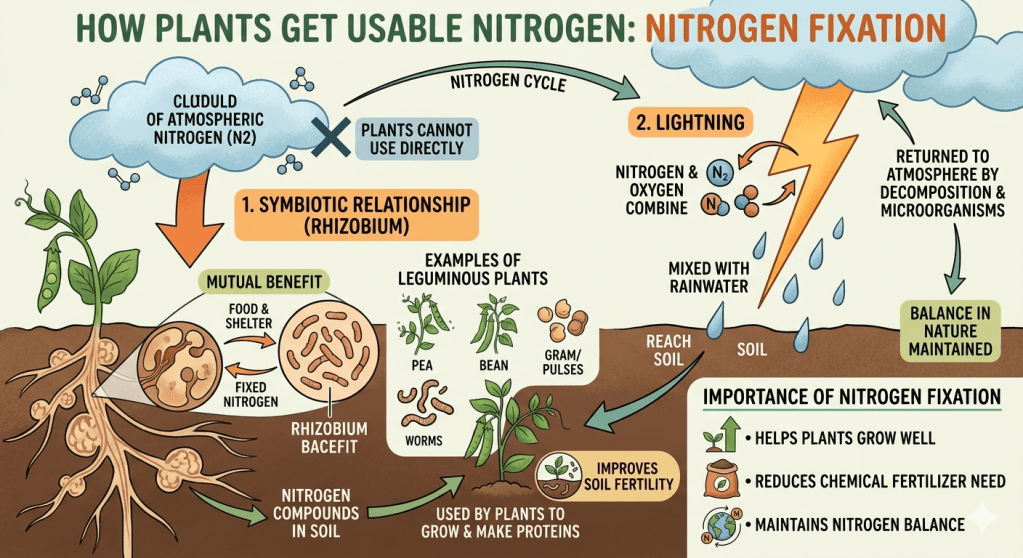
Nitrogen is very important for plants because it helps them grow and make proteins.
Although nitrogen is present in large amounts in the air, plants cannot use nitrogen directly.
So, nitrogen from the air must be converted into a usable form. This process is called nitrogen fixation.
What is Nitrogen Fixation?
Nitrogen fixation is the process of converting atmospheric nitrogen into forms that plants can use.
Nitrogen in air
↓
Converted into usable form
↓
Used by plants
Role of Rhizobium Bacteria
- Rhizobium is a useful bacterium
- It lives in the root nodules of leguminous plants
- Example of leguminous plants:
- Pea
- Bean
- Gram
- Pulses
Symbiotic Relationship
- Rhizobium gets food and shelter from the plant
- The plant gets fixed nitrogen from Rhizobium
Leguminous plant ↔ Rhizobium
(Food & shelter) (Fixed nitrogen)
How Rhizobium Fixes Nitrogen
Nitrogen in air
↓
Rhizobium in root nodules
↓
Nitrogen compounds in soil
↓
Used by plants
This improves soil fertility.
Nitrogen Fixation by Lightning
- During lightning, nitrogen and oxygen combine
- They form nitrogen compounds
- These compounds come down to the soil with rainwater
Lightning
↓
Nitrogen compounds formed
↓
Mixed with rainwater
↓
Reach soil
Why Does Atmospheric Nitrogen Remain Constant?
- Nitrogen is used by plants
- It is returned to the atmosphere by:
- Decomposition of plants and animals
- Activity of microorganisms
This maintains a balance of nitrogen in nature.
Importance of Nitrogen Fixation
- Helps plants grow well
- Increases soil fertility
- Reduces the need for chemical fertilizers
- Maintains nitrogen balance in the atmosphere
Nitrogen fixation is a natural process that helps convert nitrogen from the air into a form usable by plants.
Rhizobium bacteria play an important role in this process by living in the roots of leguminous plants and helping improve soil fertility.
 The Bio Brief
Leave a comment