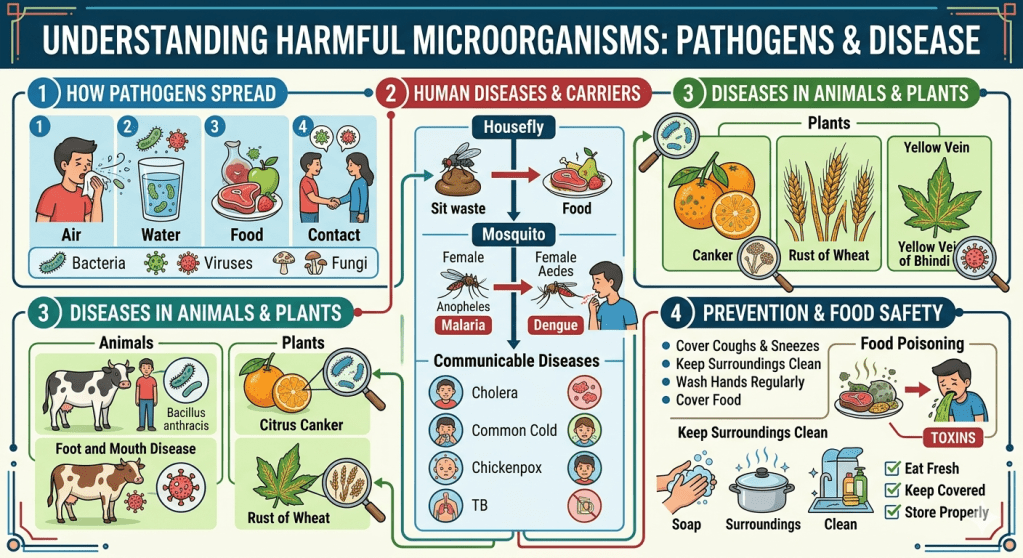
Not all microorganisms are useful. Some microorganisms are harmful and cause diseases in humans, animals, and plants.
These disease-causing microorganisms are called pathogens.
Microorganisms
|
|—— Useful
|—— Harmful (Pathogens)
They can also:
- Spoil food
- Damage clothes and leather
Disease-Causing Microorganisms in Humans
How Do Pathogens Enter Our Body?
Pathogens enter our body through:
- Air we breathe
- Water we drink
- Food we eat
- Direct contact with infected persons
- Animals or insects (carriers)
Pathogens
↓
Air / Water / Food / Contact
↓
Human body
↓
Disease
Communicable Diseases
Diseases that spread from one person to another are called communicable diseases.
Examples:
- Cholera
- Common cold
- Chicken pox
- Tuberculosis (TB)
Spread of Common Cold
- When an infected person sneezes
- Tiny droplets carrying viruses spread in air
- Healthy person breathes them in and gets infected
Sneezing
↓
Virus in air
↓
Healthy person breathes
↓
Infection
Prevention of Communicable Diseases
- Cover nose and mouth while sneezing
- Keep distance from infected persons
- Wash hands regularly
- Keep food covered
Carriers of Diseases
Some animals and insects carry disease-causing microbes. These are called carriers.
Housefly
- Sits on garbage and animal waste
- Carries pathogens on its body
- Transfers them to uncovered food
Prevention:
- Keep food covered
- Maintain cleanliness
Mosquitoes
| Mosquito | Disease Spread |
| Female Anopheles | Malaria |
| Female Aedes | Dengue |
- Mosquitoes breed in standing water
Prevention:
- Do not allow water to collect in coolers, tyres, pots
- Keep surroundings clean and dry
Disease-Causing Microorganisms in Animals
Some microorganisms also cause diseases in animals.
Examples:
- Anthrax
- Caused by bacterium Bacillus anthracis
- Affects humans and cattle
- Discovered by Robert Koch (1876)
- Foot and Mouth Disease
- Caused by a virus
- Affects cattle
Table: Animal Diseases
| Disease | Causative Agent | Mode of Transmission | Preventive Measures |
| Anthrax | Bacteria (Bacillus anthracis) | Contact with infected animals | Vaccination, proper disposal of dead animals |
| Foot and Mouth Disease | Virus | Direct contact | Vaccination, isolation of infected animals |
Disease-Causing Microorganisms in Plants
Microorganisms also cause diseases in plants like:
- Wheat
- Rice
- Potato
- Sugarcane
- Apple
- Orange
These diseases:
- Reduce crop yield
- Damage plants
They can be controlled using chemicals (pesticides) that kill microbes.
Table: Plant Diseases
| Disease | Causative Agent | Mode of Transmission | Preventive Measures |
| Citrus canker | Bacteria | Air, water | Spraying antibiotics, removing infected plants |
| Rust of wheat | Fungus | Air | Use resistant varieties, fungicides |
| Yellow vein mosaic of bhindi | Virus | Insects | Control insects, remove infected plants |
Food Poisoning
Food can become harmful when microorganisms grow on it.
What is Food Poisoning?
- Caused by eating food spoiled by microorganisms
- Microbes produce toxic substances
- Can cause vomiting, stomach pain, diarrhoea
- May be serious or even fatal
Spoiled food
↓
Growth of microbes
↓
Toxins produced
↓
Food poisoning
Prevention of Food Poisoning
- Eat fresh food
- Keep food covered
- Store food properly
- Avoid stale and uncovered food
Harmful microorganisms:
- Cause diseases in humans, animals, and plants
- Spread through air, water, food, and carriers
- Spoil food and other materials
By maintaining cleanliness, proper food habits, and preventive measures, we can protect ourselves from harmful microorganisms.


Leave a Reply