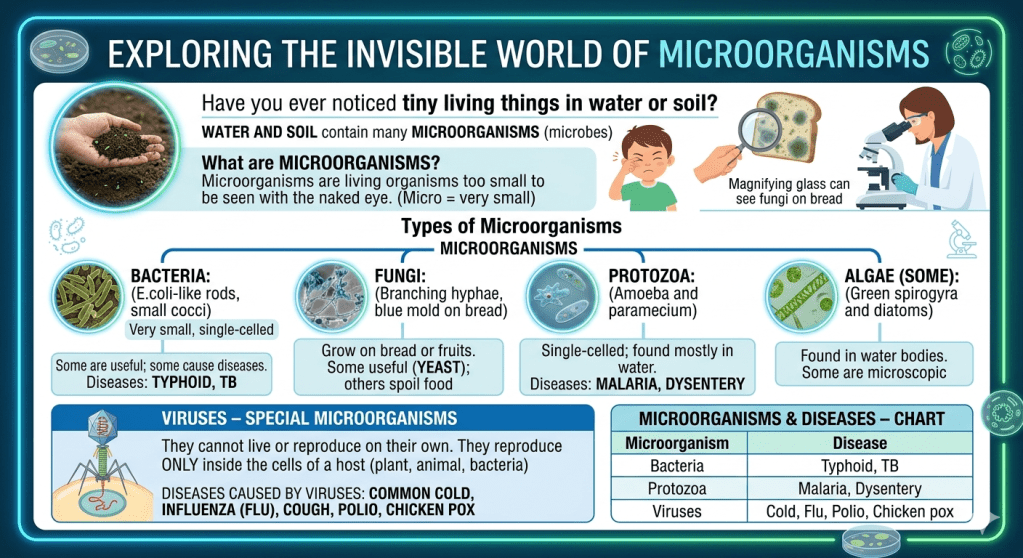
Have you ever noticed tiny living things moving in water or soil?
Water and soil contain many very small living organisms. These tiny organisms are called microorganisms or microbes.
What are Microorganisms?
- Microorganisms are living organisms that are too small to be seen with the naked eye.
- Some microorganisms, like fungus on bread, can be seen with a magnifying glass.
- Most microorganisms can be seen only with a microscope.
- Because they are very small, they are called microorganisms (micro = very small).
Types of Microorganisms
Microorganisms are mainly classified into four major groups:
Microorganisms
|
|—— Bacteria
|—— Fungi
|—— Protozoa
|—— Algae (some)
1. Bacteria
- Very small, single-celled organisms
- Some bacteria are useful, but some cause diseases
- Diseases caused by bacteria:
- Typhoid
- Tuberculosis (TB)
2. Fungi
- Can be seen growing on bread or fruits
- Some fungi are useful (like yeast), others spoil food
3. Protozoa
- Single-celled organisms found mostly in water
- Diseases caused by protozoa:
- Malaria
- Dysentery
4. Algae (Some)
- Found in water bodies
- Some algae are microscopic and are considered microorganisms
Viruses – Special Microorganisms
- Viruses are microscopic, but they are different from other microorganisms
- They cannot live or reproduce on their own
- They reproduce only inside the cells of a host (plant, animal, or bacteria)
Virus
|
|—— Needs a host cell
|—— Reproduces inside the host
Diseases Caused by Viruses
- Common cold
- Influenza (flu)
- Cough
- Polio
- Chicken pox
Microorganisms and Diseases –Chart
Microorganism Disease
Bacteria → Typhoid, TB
Protozoa → Malaria, Dysentery
Viruses → Cold, Flu, Polio, Chicken pox
Microorganisms are very small living organisms found everywhere around us. Some are useful, while others can cause diseases. Learning about microorganisms helps us understand how diseases spread and how we can protect ourselves.


Leave a Reply