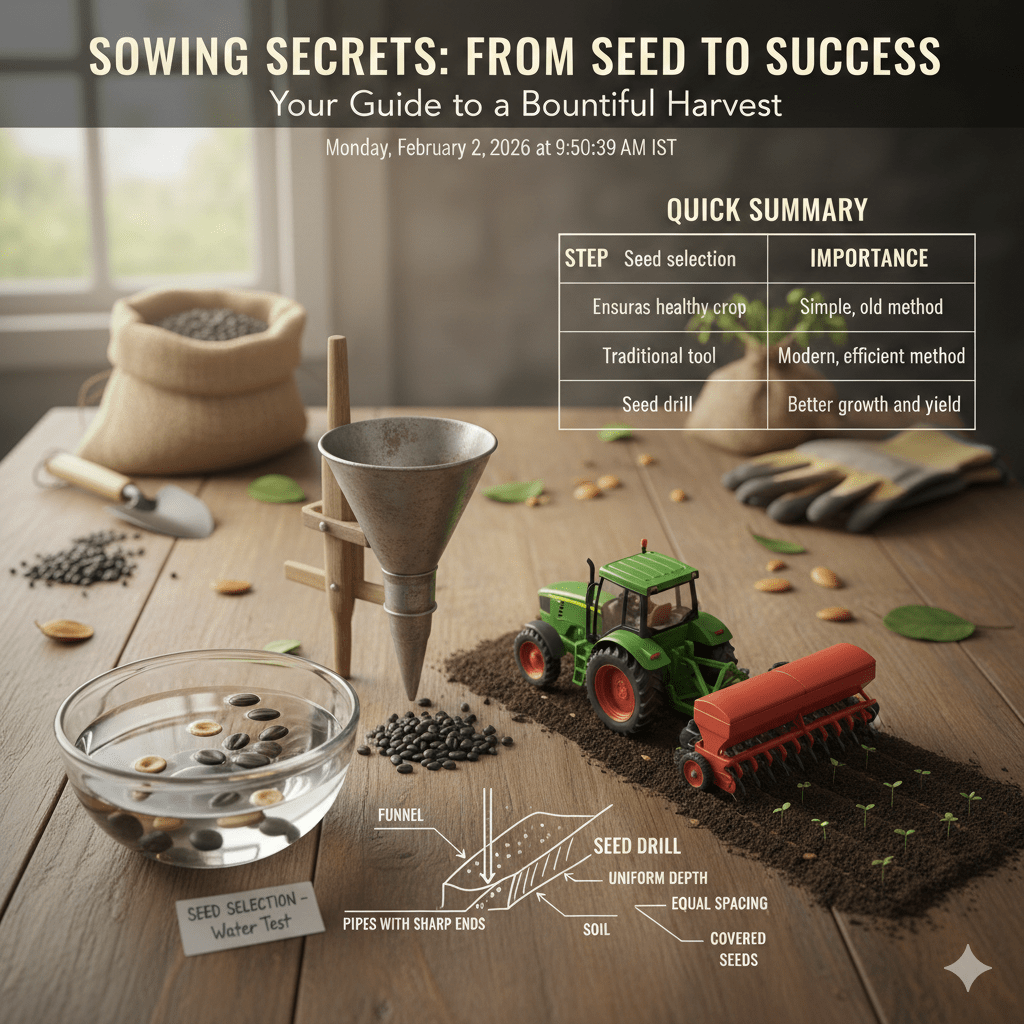
Sowing is the process of planting seeds in the soil.
It is a very important step in crop production because proper sowing helps in healthy plant growth and better yield.
Selection of Seeds
Before sowing, good quality seeds are selected.
Characteristics of Good Seeds
- Clean and healthy
- Free from diseases
- Of good variety
- Give high yield
Water Test for Seed Selection
Some seeds float on water while others sink.
- Floating seeds → Damaged or hollow → Lighter
- Sinking seeds → Healthy → Heavier
Damaged seeds become hollow and therefore float on water. This method helps farmers to separate healthy seeds from damaged ones.
Seeds + Water
↓
Floating seeds → Damaged (Rejected)
Sinking seeds → Healthy (Selected)
Methods of Sowing
1. Traditional Method
- A funnel-shaped tool is used
- Seeds are filled into the funnel
- Seeds pass through 2–3 pipes with sharp ends
- The sharp ends make holes in the soil and place seeds inside
Diagram idea:
Funnel
|
Pipes with
sharp ends
|
Soil
2. Seed Drill (Modern Method)
- Used with the help of a tractor
- Sows seeds at:
- Equal distance
- Proper depth
- Covers seeds with soil after sowing
Advantages of Seed Drill
- Saves time and labour
- Protects seeds from birds
- Ensures uniform sowing
- Helps in better growth of plants
Seed Drill
↓
Uniform depth
Equal spacing
Covered seeds
Importance of Proper Spacing
- Proper distance between seeds prevents overcrowding
- Plants get enough:
- Sunlight
- Water
- Nutrients
- If plants grow too close, some may be removed (thinning)
Quick Summary
| Step | Importance |
| Seed selection | Ensures healthy crop |
| Traditional tool | Simple, old method |
| Seed drill | Modern, efficient method |
| Proper spacing | Better growth and yield |


Leave a Reply