Introduction:
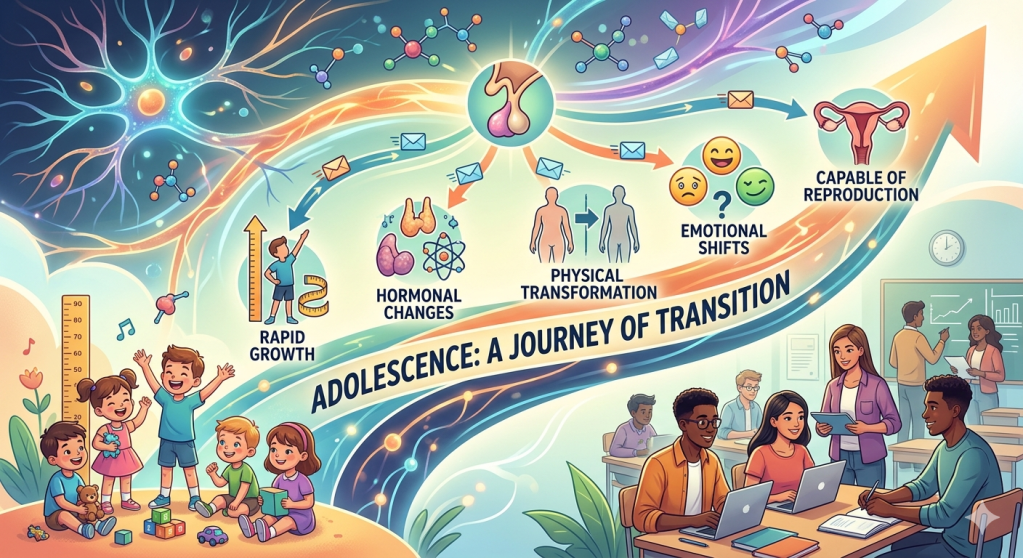
All living organisms grow and change as they move from childhood to adulthood. In humans and many animals, the ability to reproduce does not exist from birth. It develops only after the body has matured enough to support reproduction. This special stage of life, when the body begins to change and prepares for adulthood, is called adolescence.
Adolescence is the period of transition from childhood to adulthood. It usually begins between the ages of about 10 to 12 years and continues into the late teens. During this time, the body undergoes many physical, mental, and emotional changes. One of the most important changes is that the reproductive organs become fully functional, making a person capable of reproduction.
These changes do not happen suddenly on their own. They are carefully controlled by chemical substances in the body called hormones. Hormones are released by special glands and act like messengers that tell different parts of the body when and how to grow and develop. Because of hormones, adolescents experience rapid growth in height, changes in body shape, development of secondary sexual characteristics, and emotional changes.
Understanding adolescence helps us know why our bodies change in certain ways and how these changes prepare us for adulthood. In this chapter, we will learn about the role of hormones and the various changes that occur in the human body during adolescence.
 The Bio Brief
Leave a comment