What is Sexual Reproduction?
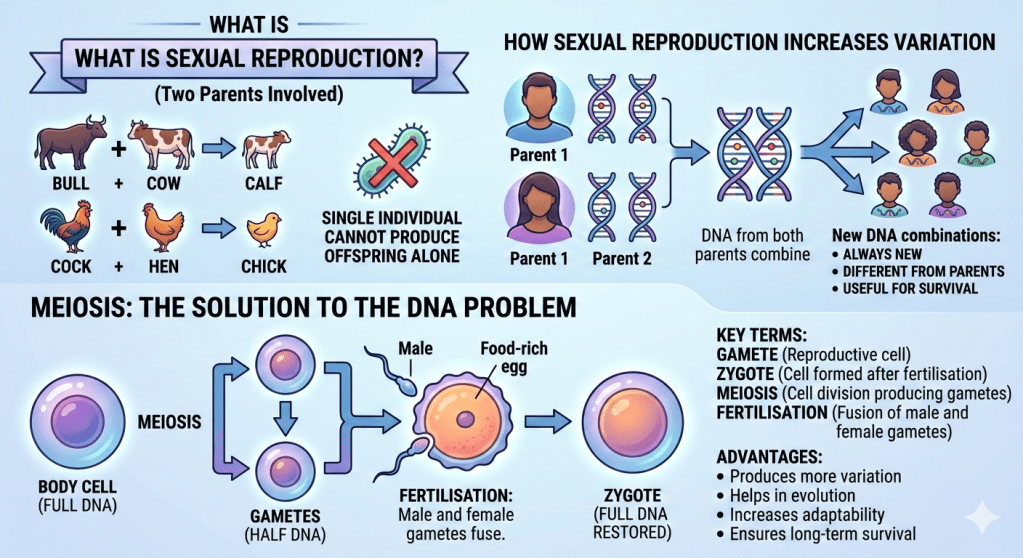
- Sexual reproduction is a mode of reproduction in which two parents (male and female) are involved.
- Both parents contribute special reproductive cells called gametes.
- Example:
- Bull + Cow → Calf
- Cock + Hen → Chick
A single individual cannot produce offspring alone.
Why Do Organisms Need Sexual Reproduction?
Limitation of Asexual Reproduction
- Asexual reproduction produces very little variation
- Variations arise slowly because DNA copying is mostly accurate
- In changing environments, this may not be enough for survival
Importance of Sexual Reproduction
Sexual reproduction:
- Produces more variation
- Helps species adapt better
- Increases chances of survival and evolution
How Does Sexual Reproduction Increase Variation?
Step-by-Step Explanation
- Every organism has small DNA variations
- Different individuals have different variations
- Sexual reproduction combines DNA from:
- One male parent
- One female parent
This creates new combinations of DNA, which are:
- Always new
- Different from parents
- Useful for survival
Flow Chart: Variation in Sexual Reproduction
Parent 1 (with variations)
+
Parent 2 (with different variations)
↓
DNA from both parents combine
↓
New DNA combinations
↓
More variation in offspring
Problem with Combining DNA (Important Concept)
If DNA from two parents is simply added:
- DNA amount will double every generation
- This will disturb:
- Cell functioning
- Control of cellular activities
So nature needs a solution.
Solution: Meiosis
What is Meiosis?
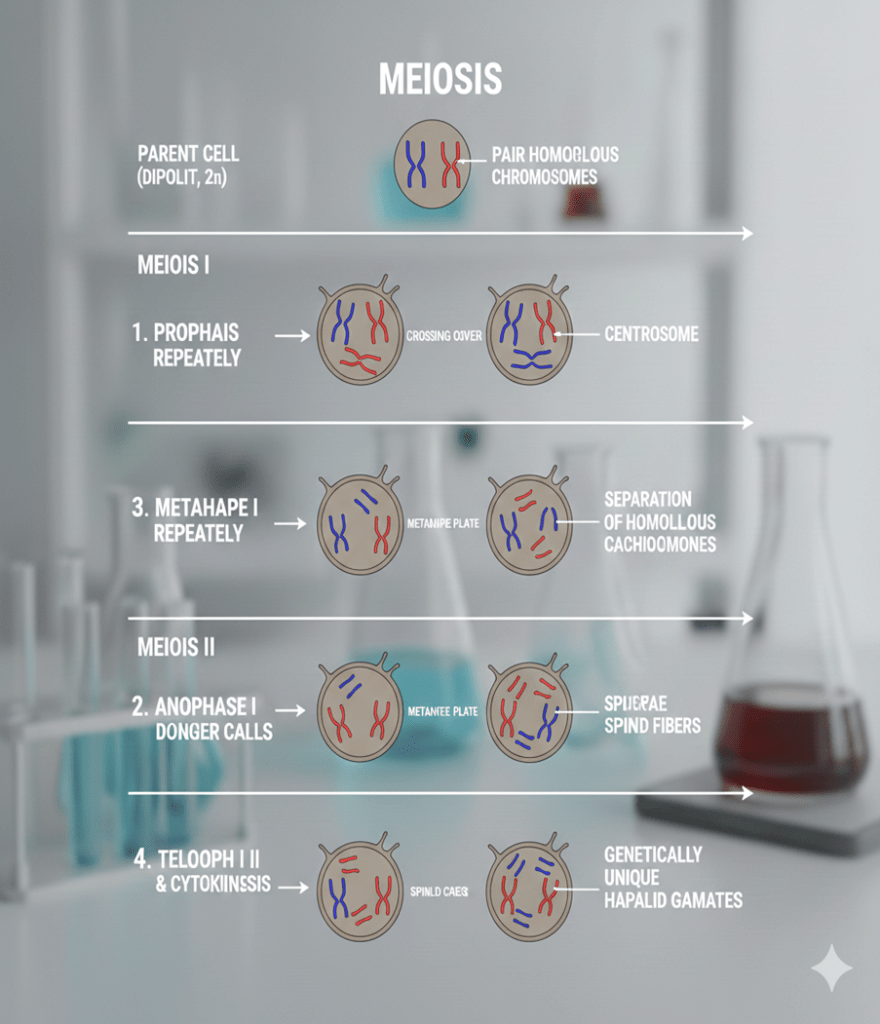
- Meiosis is a special type of cell division
- It occurs in reproductive organs
- It produces germ cells (gametes)
Key Features:
- Gametes have:
- Half the number of chromosomes
- Half the DNA compared to body cells
Flow Chart: Role of Meiosis
Body cell (Full DNA)
↓ Meiosis
Gametes (Half DNA)
↓ Fertilisation
Zygote (Full DNA restored)
This maintains a constant chromosome number in each generation.
What Happens After Fertilisation?
- Male and female gametes fuse
- A zygote is formed
- Zygote develops into a new organism
The zygote needs energy to grow and form tissues and organs.
Why Are Male and Female Gametes Different?
As organisms become more complex:
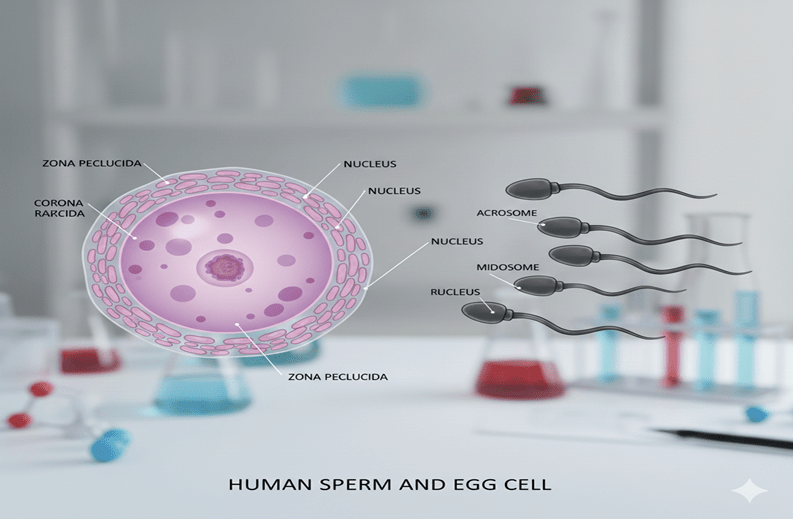
Female Gamete (Egg)
- Large in size
- Contains food storage
- Non-motile
Male Gamete (Sperm)
- Small in size
- Motile (can move)
- No food storage
Simple Diagram: Gametes
Male gamete (Sperm) → Small, motile
Female gamete (Egg) → Large, food-rich
Key Terms (Easy Meanings)
| Term | Meaning |
| Gamete | Reproductive cell |
| Zygote | Cell formed after fertilisation |
| Meiosis | Cell division producing gametes |
| Fertilisation | Fusion of male and female gametes |
Advantages of Sexual Reproduction
- Produces more variation
- Helps in evolution
- Increases adaptability
- Ensures long-term survival of species
Summary
- Sexual reproduction involves two parents
- It combines DNA from both parents
- Leads to greater variation
- Meiosis maintains chromosome number
- Male and female gametes are specialised
- Sexual reproduction supports evolution
 The Bio Brief
Leave a comment