(Asexual Reproduction)
What is Asexual Reproduction?
- Reproduction involving only one parent
- No fusion of gametes
- Offspring are genetically similar to the parent
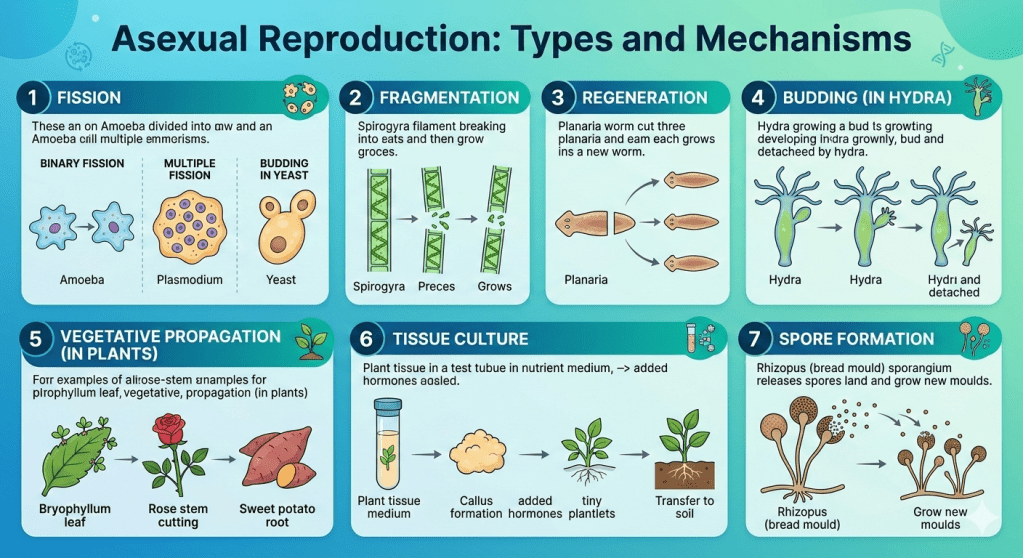
1. FISSION
Meaning:
In unicellular organisms, reproduction occurs by cell division, called fission.
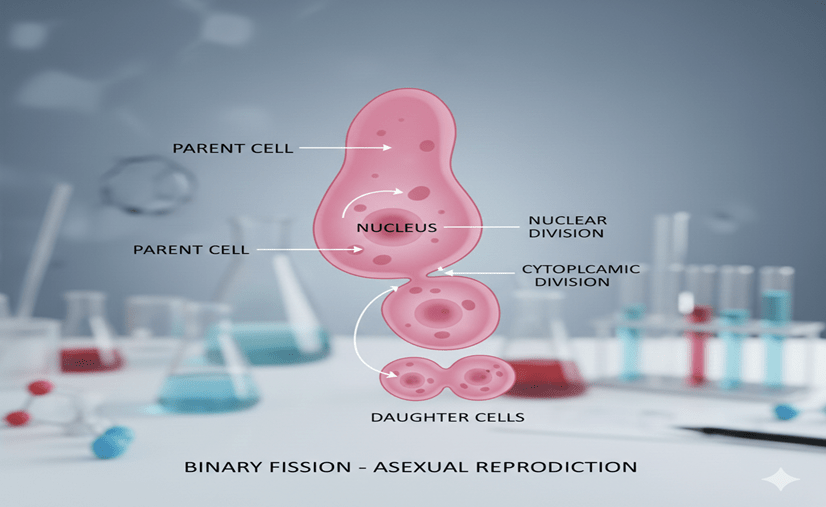
(a) Binary Fission
- One cell divides into two equal daughter cells
Examples:
- Bacteria
- Amoeba
- Leishmania
Amoeba:
- Division can occur in any plane
Amoeba
↓
Nucleus divides
↓
Cytoplasm divides
↓
Two Amoeba formed
Leishmania:
- Has a flagellum
- Division occurs in a fixed direction
(b) Multiple Fission
- One cell divides into many daughter cells at once
Example:
- Plasmodium (malarial parasite)
One Plasmodium
↓
Repeated nuclear division
↓
Many daughter cells released
(c) Budding in Yeast
- A small bud forms on the parent
- Bud grows and separates
Yeast cell
↓
Bud forms
↓
Bud grows
↓
New yeast formed
2. FRAGMENTATION
Meaning:
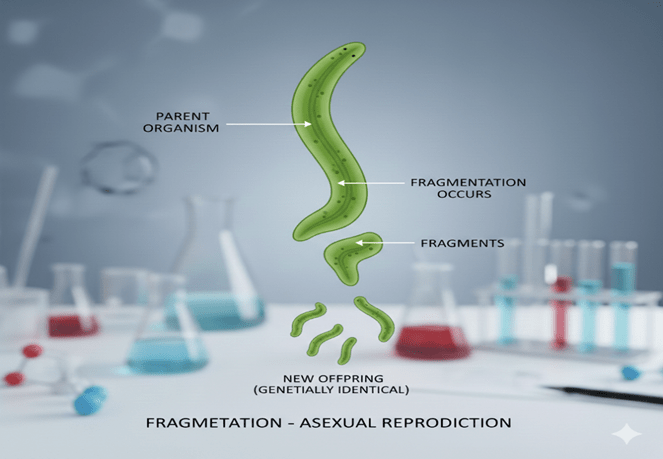
- The parent body breaks into fragments
- Each fragment grows into a new individual
Example:
- Spirogyra (algae)
Spirogyra filament
↓
Breaks into pieces
↓
Each piece → new Spirogyra
Occurs in simple multicellular organisms
Why Complex Multicellular Organisms Cannot Use Fragmentation?
- Their bodies have:
- Tissues
- Organs
- Organ systems
- Random breaking would damage organisation
Hence, they need special reproductive cells
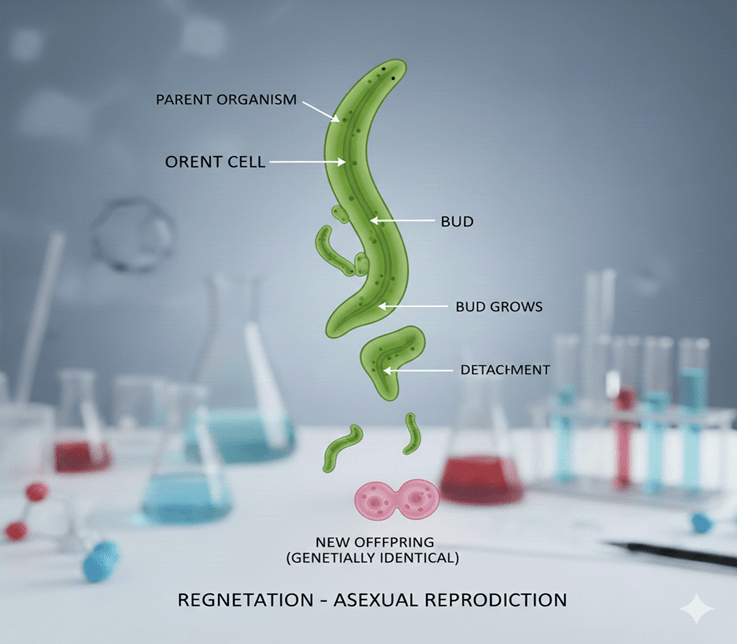
3. REGENERATION
Meaning:
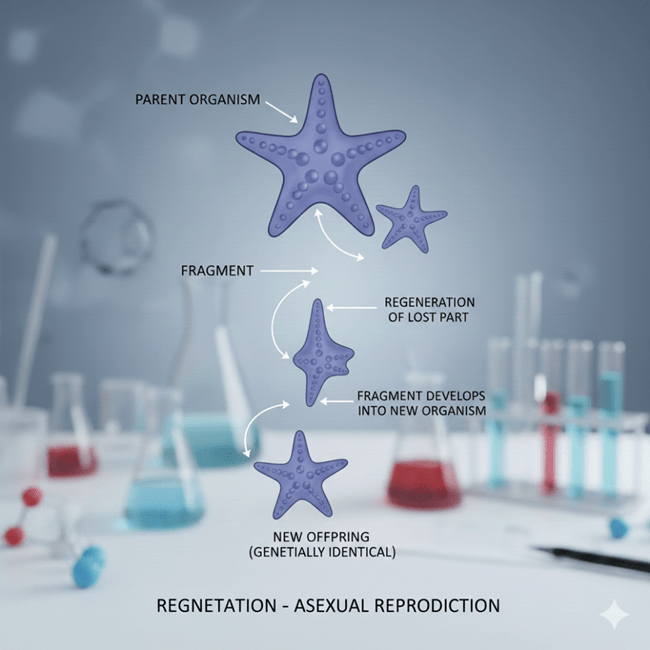
- Ability to regrow lost body parts
- In some organisms, each part can grow into a complete individual
Examples:
- Hydra
- Planaria
Planaria cut into pieces
↓
Each piece regenerates
↓
Complete organism formed
Done by special regenerative cells
Not a regular reproductive method, but a repair mechanism
4. BUDDING (in Hydra)
Meaning:
- A bud grows as an outgrowth on the parent
- Bud develops and detaches
Example:
- Hydra
Hydra
↓
Bud forms
↓
Bud grows
↓
Bud separates
↓
New Hydra
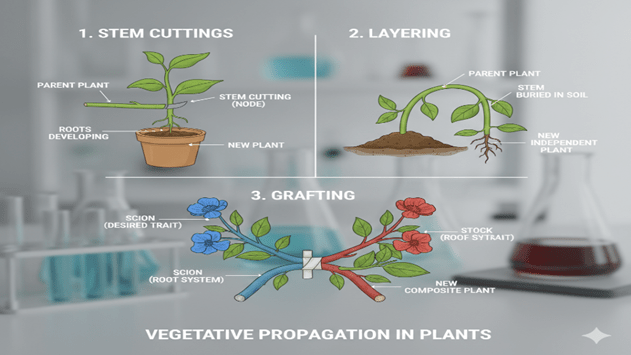
5. VEGETATIVE PROPAGATION (in Plants)
Meaning:
- New plants grow from roots, stems, or leaves
Methods:
| Plant Part | Example |
| Stem | Sugarcane, Rose |
| Leaf | Bryophyllum |
| Root | Sweet potato |
Bryophyllum Example:
- Buds form in leaf notches
- Buds fall on soil and grow
Leaf with buds
↓
Bud falls on soil
↓
New plant grows
Advantages:
- Faster reproduction
- Plants bear flowers and fruits early
- Useful for plants that do not produce seeds
- New plants are exact copies of parent
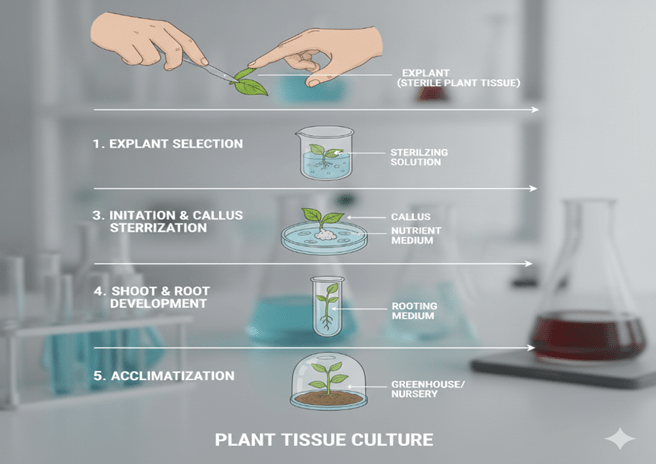
6. TISSUE CULTURE
Meaning:
- New plants grown from plant tissue in the lab
Steps (Flow Chart):
Plant tissue taken
↓
Placed in nutrient medium
↓
Cells divide → Callus formed
↓
Hormones added
↓
Plantlets formed
↓
Transferred to soil
Uses:
- Disease-free plants
- Large number of plants
- Used for ornamental plants
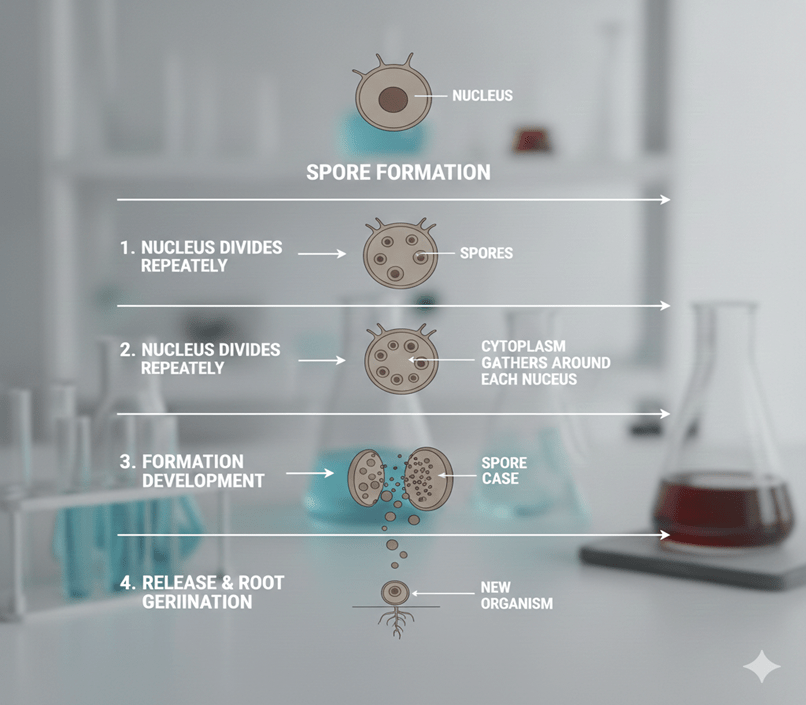
7. SPORE FORMATION
Meaning:
- Reproduction by spores
- Spores have thick protective walls
Example:
- Rhizopus (bread mould)
Sporangium
↓
Spores released
↓
Spore lands on moist surface
↓
New Rhizopus grows
Yeast vs Mould
| Feature | Yeast | Mould (Rhizopus) |
| Type | Unicellular | Multicellular |
| Method | Budding | Spore formation |
| Reproductive unit | Bud | Spore |
Summary:
- All these methods are asexual reproduction
- Only one parent involved
- Offspring are genetically similar
- Common in simple organisms and plants
 The Bio Brief
Leave a comment