Short Answer:
No, organisms do not make exact copies of themselves. They produce similar but not identical copies.
Why Do Organisms Look Similar?
- Organisms of the same species look similar because their body designs are similar.
- These body designs are controlled by instructions inside the cell.
- These instructions are called DNA.
What Is DNA?
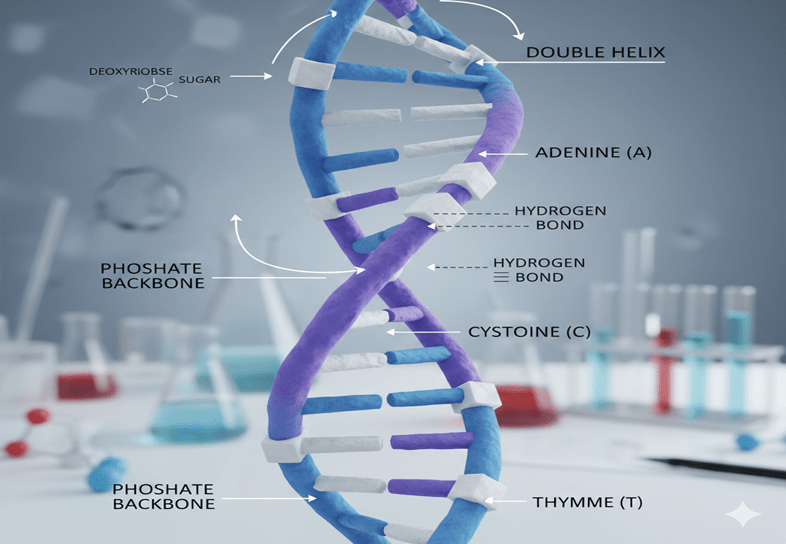
- DNA (Deoxyribo Nucleic Acid) is present in the nucleus of a cell.
- DNA is found in structures called chromosomes.
- DNA acts as a blueprint for:
- Making proteins
- Building the body structure
- Passing traits from parents to offspring
If DNA changes → proteins change → body design changes
Basic Event in Reproduction: DNA Copying
The most important step in reproduction is: Making a copy of DNA
Why?
- Because DNA carries all the information needed to make a new organism.
How Does DNA Copying Happen?
Cells use chemical reactions to make a copy of DNA.
But there’s a problem
- A DNA copy alone cannot survive
- It needs a cell structure (cytoplasm, membrane, etc.)
So, DNA copying happens along with cell division.
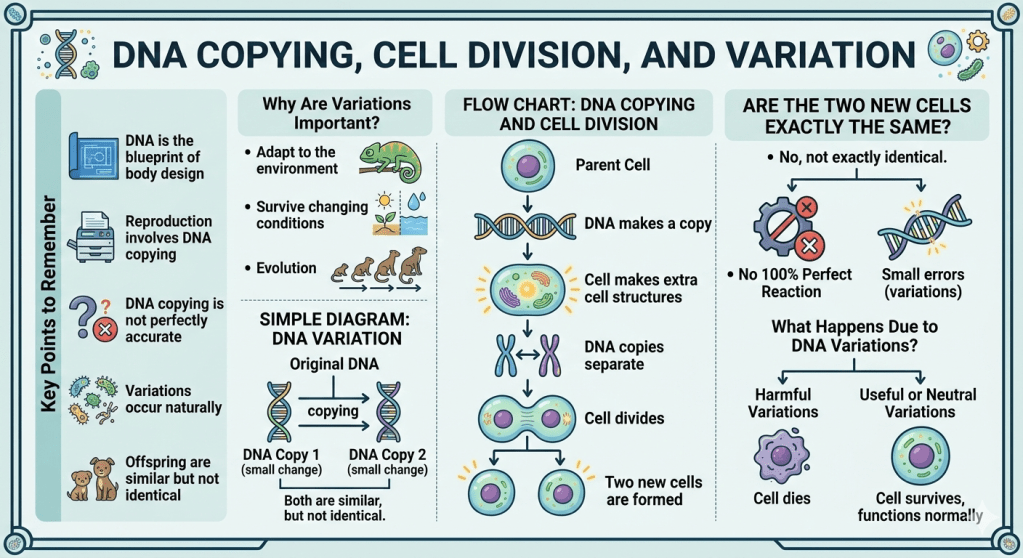
Flow Chart: DNA Copying and Cell Division
Parent Cell
↓
DNA makes a copy
↓
Cell makes extra cell structures
↓
DNA copies separate
↓
Cell divides
↓
Two new cells are formed
Are the Two New Cells Exactly the Same?
No, they are not exactly identical.
Why?
- No chemical reaction is 100% perfect
- Small errors (variations) occur during DNA copying
- So, new DNA copies are:
- Mostly similar
- Slightly different from the original
What Happens Due to DNA Variations?
Case 1: Harmful Variations
- Some DNA changes are very large
- The cell cannot function properly
- The cell dies
Case 2: Useful or Neutral Variations
- Some variations are small
- The cell survives and functions normally
- Cells are similar but not exactly the same
Simple Diagram: DNA Variation
Original DNA
↓ copying
DNA Copy 1 (small change)
DNA Copy 2 (small change)
➡ Both are similar, but not identical.
Why Are Variations Important?
- Variations help organisms:
- Adapt to the environment
- Survive changing conditions
- Over many generations, these variations lead to: Evolution
This is why variation is necessary for evolution.
Key Points to Remember
- DNA is the blueprint of body design
- Reproduction involves DNA copying
- DNA copying is not perfectly accurate
- Variations occur naturally
- Offspring are similar but not identical
- Variations are the basis of evolution
 The Bio Brief
Leave a comment