Introduction:
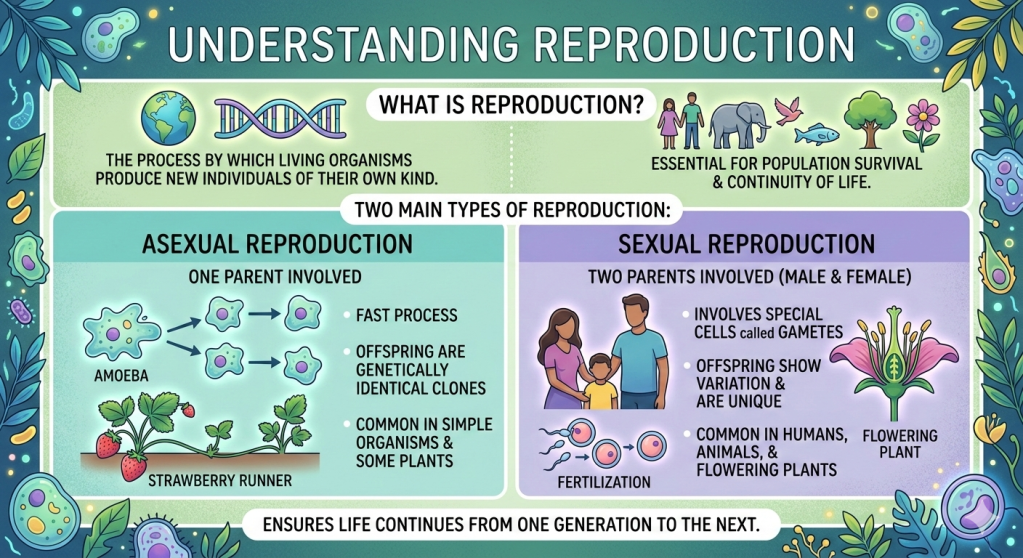
All living organisms—plants, animals, and even tiny microorganisms—have one important thing in common: they can reproduce. Reproduction is the process by which living organisms produce new individuals of their own kind. Without reproduction, life on Earth would not continue.
Reproduction is important because it helps organisms maintain their population and pass on their characteristics (like eye color in humans or leaf shape in plants) from one generation to the next. These characteristics are carried by special units called genes.
Organisms reproduce in two main ways: asexual reproduction and sexual reproduction.
In asexual reproduction, only one parent is involved. The new organism is usually exactly like the parent. This type of reproduction is common in simple organisms such as bacteria, amoeba, and some plants. It is a fast process and does not require finding a partner.
In sexual reproduction, two parents are involved—usually a male and a female. Each parent contributes special cells called gametes. The offspring produced is not exactly the same as either parent, which leads to variation. This type of reproduction is common in humans, animals, and flowering plants and helps organisms adapt better to their environment.
Different organisms use different methods of reproduction depending on their structure, environment, and complexity. No matter the method, reproduction ensures that life continues from one generation to the next.
 The Bio Brief
Leave a comment