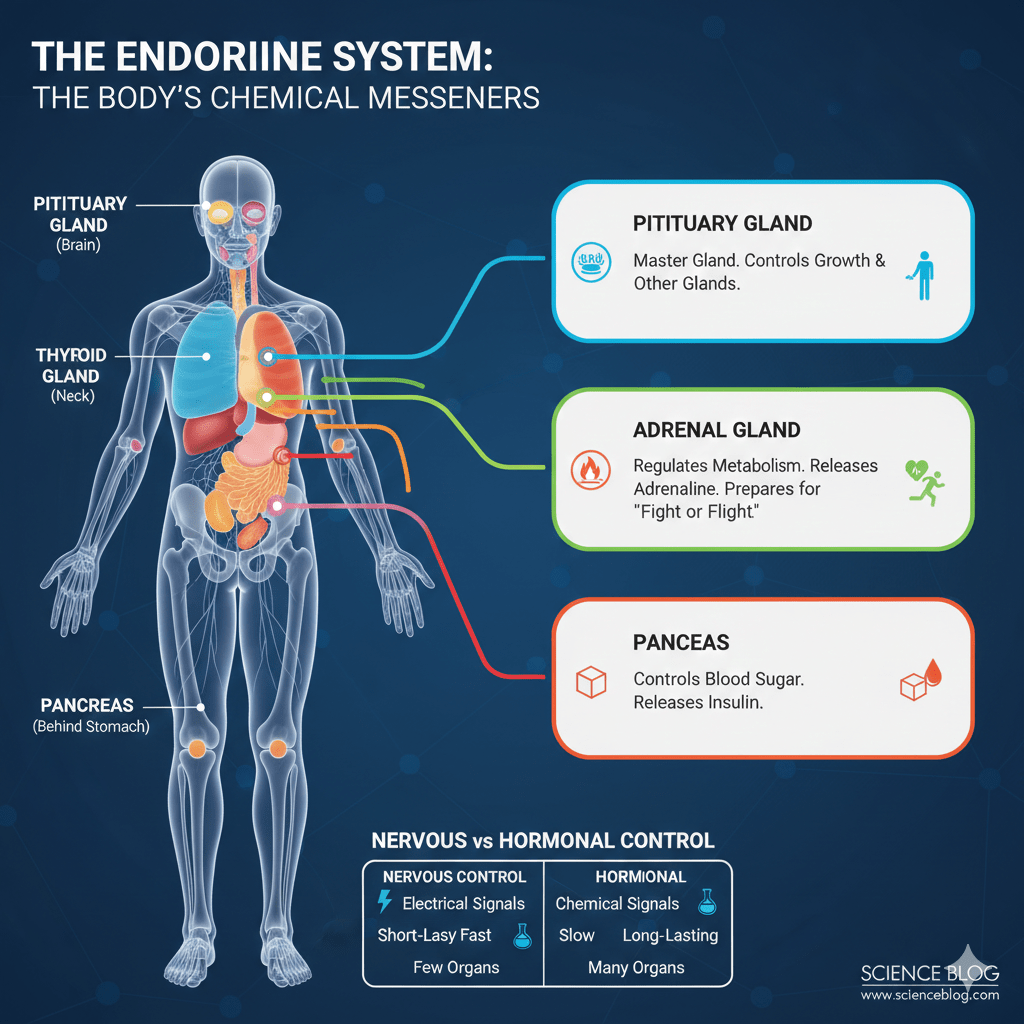
What are Hormones?
- Hormones are chemical messengers.
- They are released by endocrine glands.
- They travel through blood to reach target organs.
- They help in control and coordination of body activities.
Unlike nerves (electrical signals), hormones:
- Act slowly
- Affect many organs at the same time
- Have long-lasting effects
Why are Hormones Needed?
Some situations need whole-body preparation, not just one organ.
Example: A squirrel in danger
- It must fight or run
- Needs:
- More energy
- Faster breathing
- More blood to muscles
This is done using a hormone called adrenaline.
Adrenaline – “Emergency Hormone”
- Secreted by: Adrenal glands
- Released directly into blood
Effects of Adrenaline:
Danger / Fear
↓
Adrenal glands release adrenaline
↓
Blood carries adrenaline
↓
Target organs respond
Changes in the body:
- Heart beats faster → more oxygen to muscles
- Breathing rate increases
- Blood supply to digestion decreases
- Blood supply to skeletal muscles increases
Result: Body is ready to fight or run
Endocrine System
- A group of hormone-secreting glands
- Controls:
- Growth
- Metabolism
- Puberty
- Blood sugar
- Stress responses
Role of Hormones in Growth
Animals don’t grow in random directions like plants.
Growth is controlled and specific.
Example:
- We grow hands where hands should be
- Not fingers on the face
Hormones ensure proper body design.
Important Hormones and Their Functions
1. Thyroxin
- Gland: Thyroid gland
- Needs: Iodine
- Function:
- Regulates metabolism of:
- Carbohydrates
- Proteins
- Fats
- Supports growth and energy balance
- Regulates metabolism of:
Iodised salt provides iodine
Iodine deficiency → Goitre (swollen neck)
Low iodine
↓
Less thyroxin
↓
Poor metabolism
↓
Goitre
2. Growth Hormone
- Gland: Pituitary gland
- Function:
- Controls height and body growth
Deficiency in childhood → Dwarfism
Excess → Gigantism
3. Sex Hormones (Puberty Changes)
| Hormone | Released in | Effects |
| Testosterone | Males | Deep voice, beard, muscles |
| Oestrogen | Females | Breast development, wider hips |
Responsible for puberty changes (10–12 years)
4. Insulin
- Gland: Pancreas
- Function:
- Controls blood sugar level
Less insulin → Diabetes
Patients may need insulin injections
High blood sugar
↓
Pancreas releases insulin
↓
Sugar enters cells
↓
Blood sugar decreases
Feedback Mechanism (Very Important!)
Hormone release is self-regulated.
Example: Insulin
Blood sugar rises
↓
Pancreas secretes insulin
↓
Blood sugar falls
↓
Insulin secretion reduces
This keeps hormone levels balanced
Key Differences: Nervous vs Hormonal Control
| Nervous Control | Hormonal Control |
| Electrical signals | Chemical signals |
| Very fast | Slow |
| Short-lasting | Long-lasting |
| Acts on few organs | Acts on many organs |
SUMMARY
- Hormones = chemical messengers
- Travel through blood
- Control growth, metabolism, stress, puberty
- Adrenaline prepares body for emergencies
- Thyroxin needs iodine
- Growth hormone controls height
- Insulin controls blood sugar
- Feedback mechanism maintains balance
 The Bio Brief
Leave a comment