What Is Movement Due to Growth?
- Some plant movements happen because of growth.
- These movements are:
- Slow
- Permanent
- Directional
- Since growth occurs more on one side than the other, the plant appears to move.
Example 1: Tendrils in Pea Plant
- Tendrils help the plant climb and get support.
- Tendrils are sensitive to touch.
What happens when a tendril touches a support?
- The side touching the support grows slowly.
- The side away from the support grows faster.
- This uneven growth causes the tendril to coil around the support.
Flow Chart:
Tendril touches support
⬇
Unequal growth
⬇
Tendril curls
⬇
Plant gets support
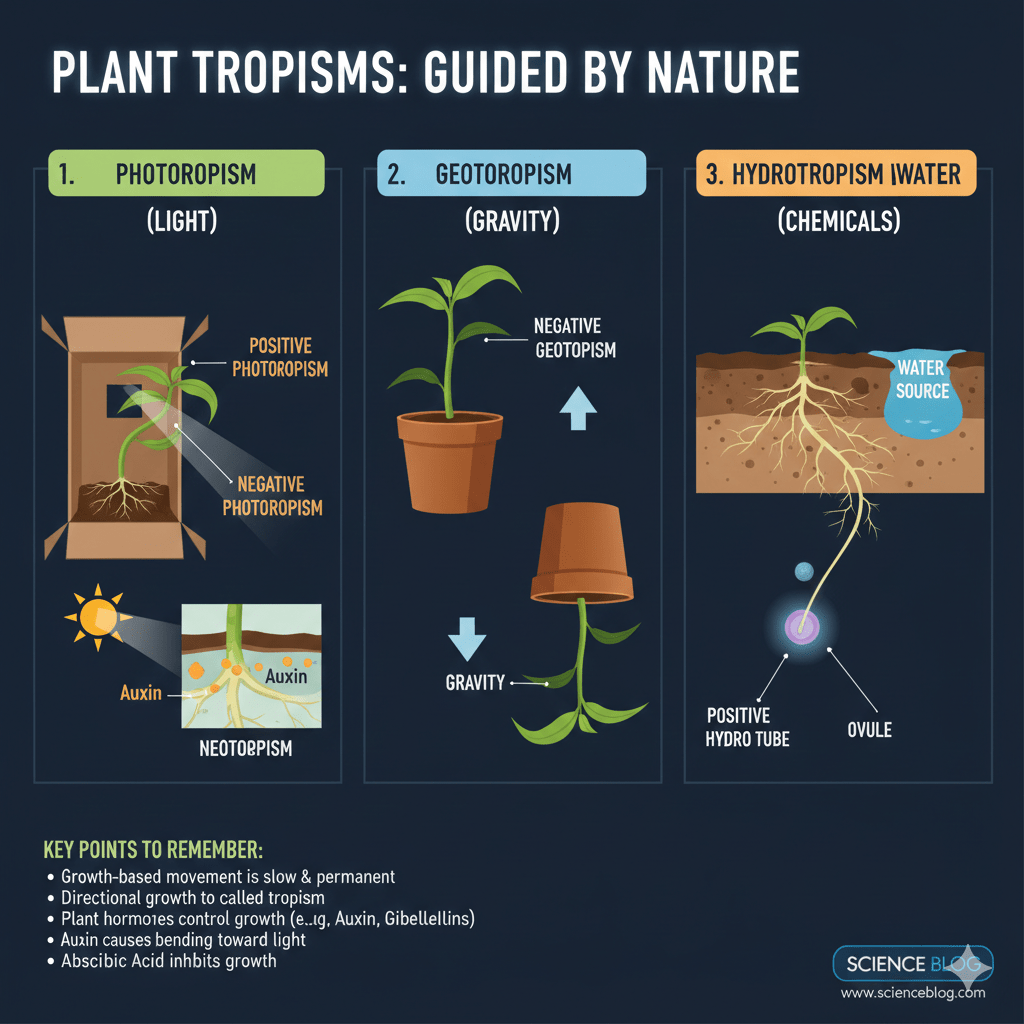
Directional Growth Movements (Tropism)
Movement of plant parts in response to a stimulus is called tropism.
Types of Tropic Movements:
- Towards stimulus → Positive tropism
- Away from stimulus → Negative tropism
Phototropism (Response to Light)
- Shoots grow towards light → Positive phototropism
- Roots grow away from light → Negative phototropism
Why is this helpful?
- Shoots get more light for photosynthesis
- Roots remain in soil for water and minerals
Geotropism (Response to Gravity)
- Roots grow downwards → Positive geotropism
- Shoots grow upwards → Negative geotropism
Other Types of Tropism
| Tropism | Stimulus | Example |
| Hydrotropism | Water | Roots grow towards water |
| Chemotropism | Chemicals | Pollen tube grows towards ovule |
Simple Diagram (Text Form)
Phototropism:
Light →
Shoot bends towards light
Root bends away from light
Geotropism:
Shoot ↑
Root ↓
(Gravity)
How Is Information Communicated in Plants?
Fast vs Slow Responses:
- Touch-me-not → Fast response
- Sunflower movement → Slow response
- Growth movements → Very slow
Electrical vs Chemical Signals
Electrical Signals:
- Very fast
- Limited to connected cells
- Cannot be continuous
Chemical Signals (Hormones):
- Slow
- Reach many cells
- Act for a longer time
- Used for growth and development
Plant Hormones (Phytohormones)
Plant hormones are chemical messengers that control growth and responses.
Important Plant Hormones:
1. Auxin
- Helps in cell elongation
- Produced at shoot tip
- Causes bending towards light
Auxin Flow Chart:
Light from one side
⬇
Auxin moves to shady side
⬇
Cells elongate more
⬇
Shoot bends towards light
2. Gibberellins
- Help in stem growth
3. Cytokinins
- Promote cell division
- Found in fruits and seeds
4. Abscisic Acid
- Inhibits growth
- Causes wilting of leaves
- Helps plants survive stress
Key Points to Remember
- Growth-based movement is slow and permanent
- Directional growth is called tropism
- Plant hormones control growth
- Auxin helps in bending towards light
- Abscisic acid stops growth
 The Bio Brief
Leave a comment