Can Plants Respond Immediately?
Yes.
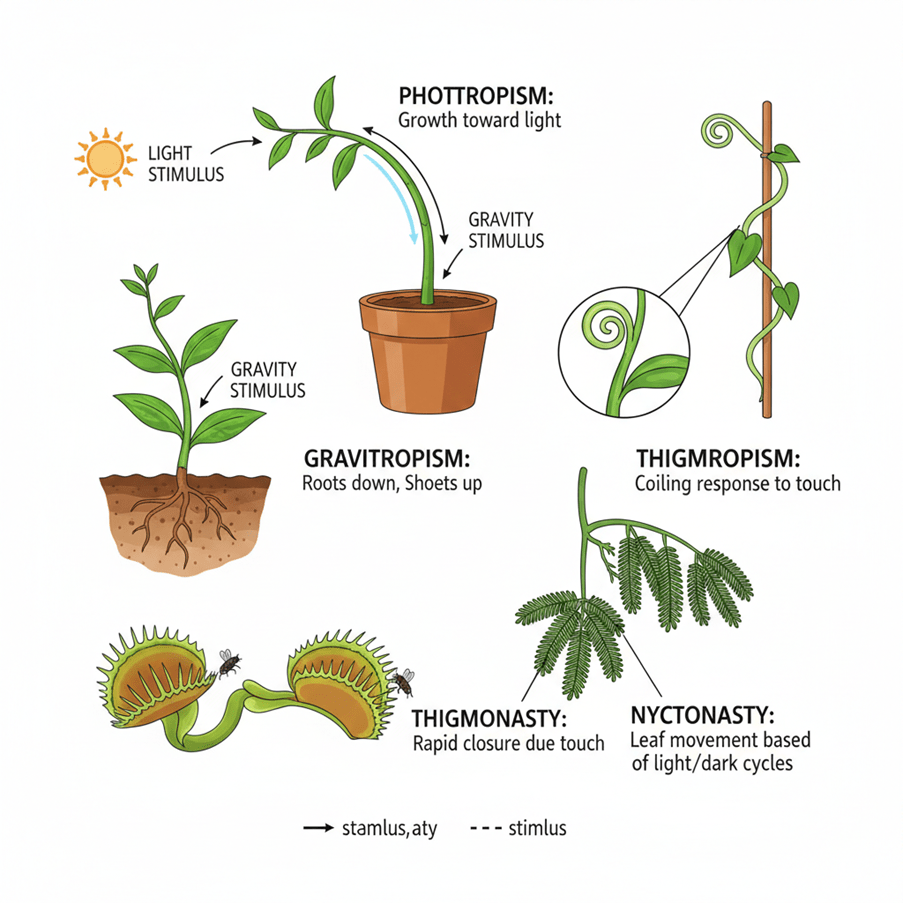
Some plants show quick responses even though they:
- Do not have a nervous system
- Do not have muscles
Example:
- Touch-me-not (Mimosa) plant folds its leaves when touched.
How Do Plants Detect Touch?
- When the plant is touched, cells at the touched part detect the stimulus.
- The movement, however, happens at a different part of the plant.
- So, the information about touch must be passed from cell to cell.
How Is Information Transmitted in Plants?
- Plants use electrical-chemical signals to send information.
- Unlike animals:
- Plants do not have nerves
- There is no specialised tissue for conduction
- The signal spreads slowly from one cell to another.
How Do Plant Leaves Move Without Muscles?
Key Idea:
Plant cells change shape to cause movement.
How does this happen?
- Plant cells control the amount of water inside them.
- When water enters:
- Cells swell
- When water leaves:
- Cells shrink
This swelling and shrinking causes the leaf to fold or droop.
Flow Chart: Touch-me-not Plant Movement
Touch (stimulus)
⬇
Cells detect touch
⬇
Electrical-chemical signal spreads
⬇
Water moves in/out of cells
⬇
Cells change shape
⬇
Leaves fold
Simple Diagram (Text Form)
Touch
↓
Signal in cells
↓
Water movement
↓
Cell shape change
↓
Leaf movement
Comparison with Animals
| Animals | Plants |
| Have nerves | No nerves |
| Have muscles | No muscles |
| Use muscle proteins | Use water movement |
| Fast responses | Comparatively slower |
Key Points to Remember
- Immediate plant movements do not involve growth
- Plants use electrical-chemical signals
- Movement happens due to change in water content of cells
- Example: Mimosa leaf folding
 The Bio Brief
Leave a comment