Do Plants Have a Nervous System?
No.
Plants do not have:
- Nervous system
- Muscles
Yet, plants can still respond to stimuli like:
- Touch
- Light
- Gravity
- Water
This ability is called coordination in plants.
How Do Plants Respond to Stimuli?
Plants respond using:
- Changes in cell shape
- Growth
- Chemical signals (plant hormones)
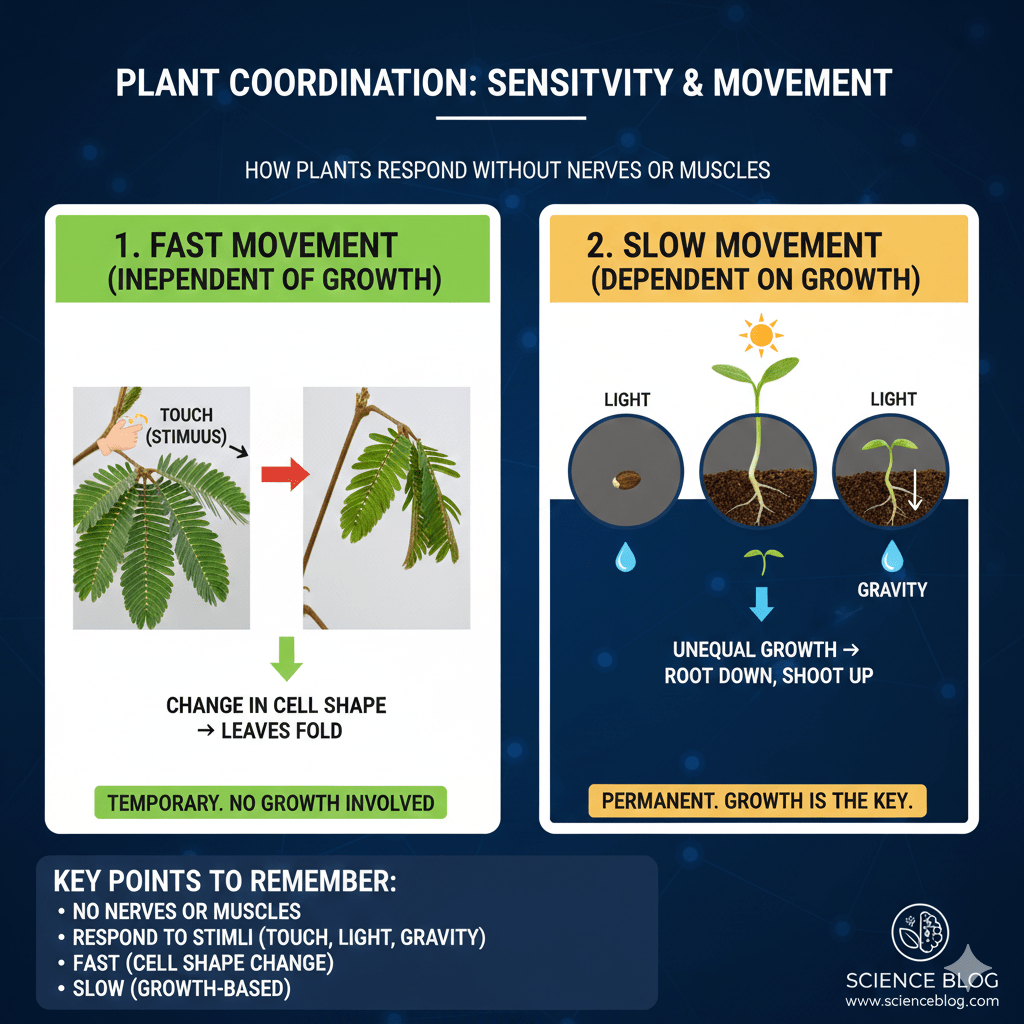
Example 1: Touch-me-not Plant (Mimosa)
- When we touch its leaves, they fold and droop.
- This movement is:
- Very fast
- Not due to growth
- Temporary
Flow Chart:
Touch (stimulus)
⬇
Signal in plant cells
⬇
Change in cell shape
⬇
Leaves fold
This movement happens without growth.
Example 2: Germinating Seed
- When a seed germinates:
- Root grows downward (towards gravity)
- Shoot grows upward (towards light)
This movement is:
- Slow
- Permanent
- Due to growth
Flow Chart:
Seed germinates
⬇
Unequal growth in plant parts
⬇
Root down, shoot up
If growth is stopped, this movement does not occur.
Types of Movements in Plants
Plants show two types of movements:
1. Movement Independent of Growth
- Fast
- Reversible
- No increase in size
Example:
Folding of Mimosa leaves on touch
2. Movement Dependent on Growth
- Slow
- Permanent
- Caused by growth
Example:
Bending of stem towards light
Growth of root towards water
Simple Comparison Table
| Movement without Growth | Movement with Growth |
| Fast | Slow |
| Temporary | Permanent |
| No growth involved | Growth involved |
| Mimosa leaf movement | Seedling growth |
Simple Diagrams (Text Form)
Mimosa Plant:
Touch
↓
Cell change
↓
Leaves fold
Seedling Growth:
Seed
↓
Root → Down
Shoot → Up
Key Points to Remember
- Plants do not have nerves or muscles
- They still respond to stimuli
- Some movements are quick (no growth)
- Some movements are slow (growth-based)
 The Bio Brief
Leave a comment