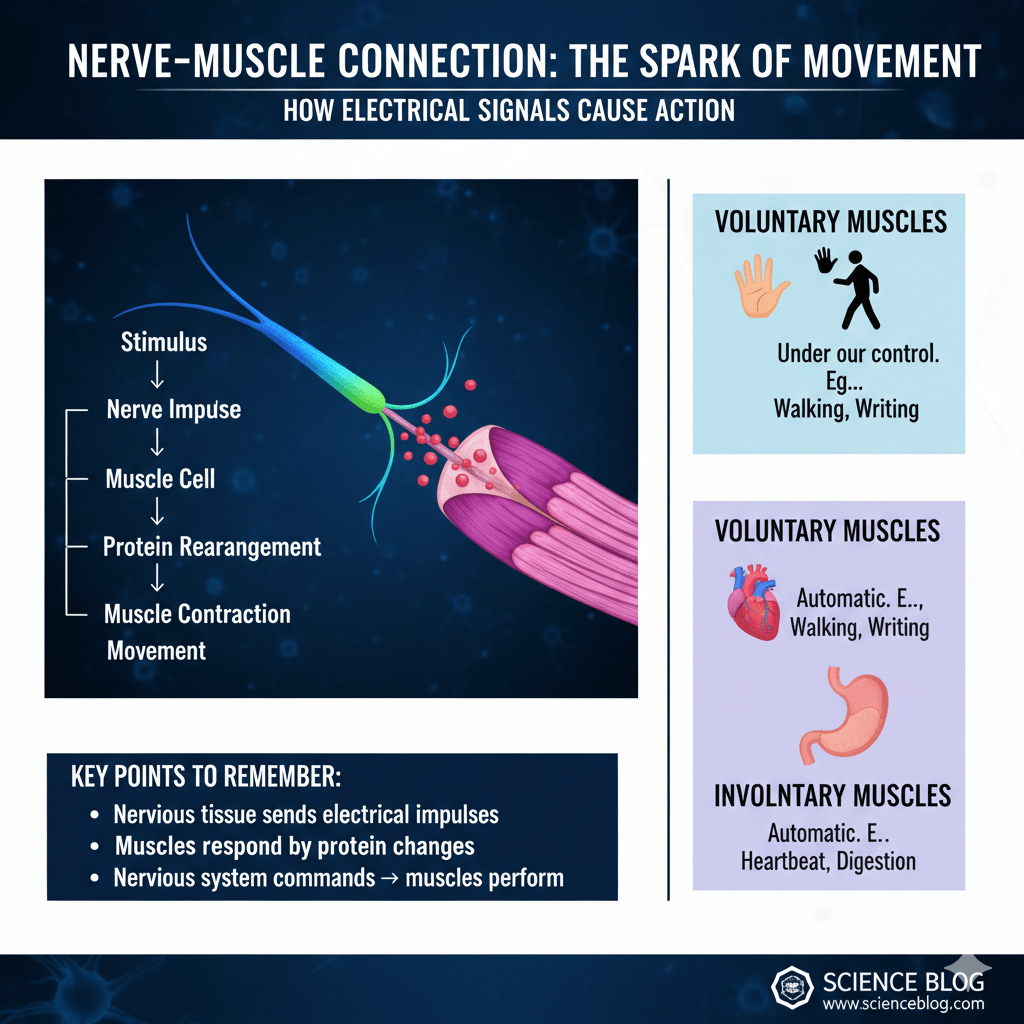
Basic Idea
- Nervous tissue carries messages (nerve impulses).
- Muscle tissue does the actual work (movement).
- When a nerve message reaches a muscle, the muscle contracts and causes movement.
Nervous tissue controls, muscle tissue acts.
How Does a Muscle Move?
Step-by-step Explanation
- A nerve impulse reaches the muscle fibre.
- The muscle fibre responds by changing its shape.
- It becomes shorter and thicker.
- This shortening is called muscle contraction.
- Contraction causes movement of body parts.
What Happens Inside a Muscle Cell?
At the cellular level:
- Muscle cells contain special proteins.
- These proteins:
- Change their shape
- Change their arrangement
- This happens in response to electrical nerve impulses.
- The rearrangement makes the muscle cell shorter.
Flow Chart: Nervous Tissue Causing Action
Stimulus
⬇
Nerve impulse generated
⬇
Impulse travels through neuron
⬇
Impulse reaches muscle cell
⬇
Muscle proteins rearrange
⬇
Muscle shortens (contracts)
⬇
Movement occurs
Simple Diagram (Text Form)
Nerve Impulse
↓
Muscle Cell
↓
Protein rearrangement
↓
Muscle contraction
↓
Movement
Types of Muscles
1. Voluntary Muscles
- Under our control
- Work according to nerve signals from the brain
- Found in arms, legs, face
Examples:
Walking, writing, lifting a bag
2. Involuntary Muscles
- Not under our control
- Work automatically
- Controlled by nervous system without thinking
Examples:
Heartbeat, movement of food in stomach, breathing
Differences Between Voluntary and Involuntary Muscles
| Voluntary Muscles | Involuntary Muscles |
| Under conscious control | Not under conscious control |
| Controlled by brain | Controlled automatically |
| Found in limbs | Found in internal organs |
| Act slowly and carefully | Act continuously |
Key Points to Remember
- Nervous tissue sends electrical impulses
- Muscles respond by contracting
- Muscle contraction is due to protein changes
- Nervous system decides → muscles perform
- Movement is a result of coordination between nerves and muscles
 The Bio Brief
Leave a comment