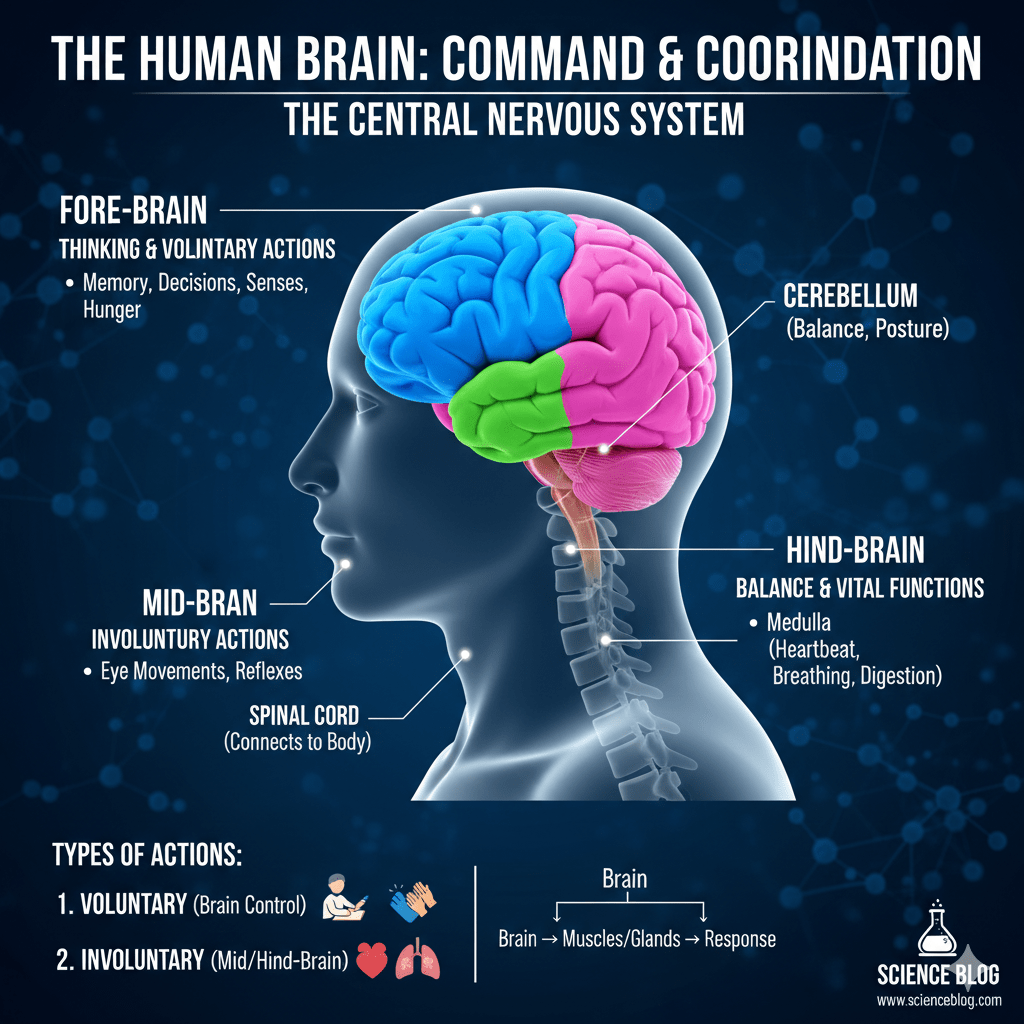
Is spinal cord only for reflex actions?
No.
We are thinking beings, so control and coordination cannot depend only on reflex actions.
- The spinal cord carries messages to and from the brain.
- Thinking, decision-making, and memory are done by the brain.
Central Nervous System (CNS)
The brain and spinal cord together form the Central Nervous System.
Functions of CNS:
- Receives information from all parts of the body
- Thinks and makes decisions
- Sends messages to muscles and glands
- Coordinates body activities
Peripheral Nervous System (PNS)
- Connects CNS to the rest of the body
- Made up of:
- Cranial nerves (from brain)
- Spinal nerves (from spinal cord)
Types of Actions
1. Voluntary actions (under our control)
Examples:
- Writing
- Talking
- Moving a chair
- Clapping
Controlled by the brain
2. Involuntary actions (not under our control)
Examples:
- Breathing
- Heartbeat
- Digestion
- Salivation
Controlled by mid-brain and hind-brain
Main Parts of the Human Brain
The brain has three major regions:
- Fore-brain
- Mid-brain
- Hind-brain
1. Fore-Brain (Thinking Brain)
Functions:
- Main thinking and decision-making centre
- Receives sensory information:
- Sight
- Hearing
- Smell
- Taste
- Interprets information
- Controls voluntary muscles
- Contains centres for hunger and emotions
Example Flow:
Seeing food
⬇
Fore-brain interprets
⬇
Feeling hungry or full
⬇
Decision to eat or stop eating
2. Mid-Brain (Involuntary Actions)
- Controls some involuntary movements
- Helps in:
- Eye movements
- Reflexes related to sight and sound
3. Hind-Brain
Parts of Hind-Brain:
- Medulla
- Cerebellum
(a) Medulla
Controls vital involuntary actions such as:
- Breathing
- Heartbeat
- Blood pressure
- Salivation
- Vomiting
We do not think to perform these actions.
(b) Cerebellum
Controls:
- Balance
- Posture
- Precision of movements
Examples:
- Walking straight
- Riding a bicycle
- Picking up a pencil
Simple Diagram of Human Brain (Text Form)
Fore-brain → Thinking, voluntary actions
Mid-brain → Involuntary actions
Hind-brain → Balance, breathing, heartbeat
|____ Cerebellum – balance
|____ Medulla – vital functions
Why Is the Brain Important?
- Allows us to think
- Helps us decide and act
- Controls both voluntary and involuntary actions
- Keeps the body balanced and alive
Key Points to Remember
- Brain + spinal cord = Central Nervous System
- Fore-brain → thinking and voluntary actions
- Mid-brain & hind-brain → involuntary actions
- Cerebellum → balance and posture
- Medulla → heartbeat, breathing, digestion
 The Bio Brief
Leave a comment