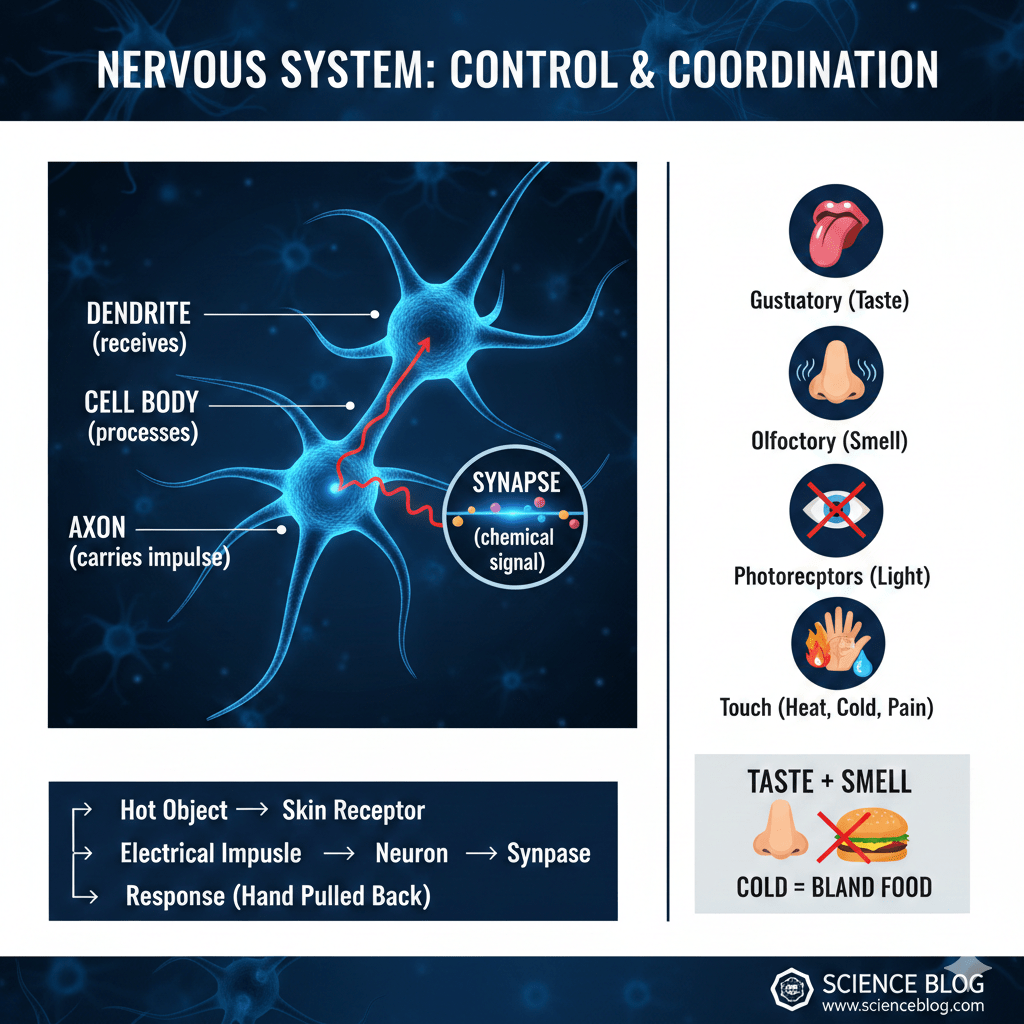
What provides control and coordination in animals?
In animals, control and coordination are carried out by:
- Nervous tissue (fast response)
- Muscular tissue (action like movement)
These systems help us detect changes and respond quickly, especially in dangerous situations.
Example: Touching a Hot Object
Touching something hot is dangerous, so our body must:
- Detect the heat
- Send the message to the brain/spinal cord
- Respond quickly by pulling the hand away
How do we detect information from our surroundings?
Receptors
- Receptors are specialised tips of nerve cells.
- They are present in sense organs.
Types of receptors:
- Gustatory receptors → detect taste (tongue)
- Olfactory receptors → detect smell (nose)
- Auditory receptors → detect sound (ear)
- Photoreceptors → detect light (eyes)
- Touch receptors → detect heat, cold, pain (skin)
How does a nerve impulse travel?
Step-by-step flow chart:
Stimulus(hot object)→Receptor in skin→ Electrical impulse is created → Dendrite → Cell body → Axon → Synapse(gap) → Chemical signal → Next neuron/muscle cell → Response (hand pulled back)
Structure of a Neuron
Dendrite → Cell Body → Axon → Synapse
| | | |
Receives Processes Carries Converts
message message impulse to chemical
Answers to the questions:
- Where information is acquired: Dendrite
- Where information travels as electrical impulse: Axon
- Where impulse becomes a chemical signal: Synapse (axon end)

- A synapse is the small gap between two neurons.
- Electrical impulse cannot jump the gap.
- It is converted into a chemical signal to cross the synapse.
Why does food taste different when the nose is blocked?
Yes, there is a difference.
Reason:
- Taste and smell work together.
- When your nose is blocked:
- Olfactory receptors cannot detect smell.
- Only taste receptors work → food tastes bland.
Example:
- Sugar tastes sweet, but its full flavour is missing.
This also happens when you have a cold, because mucus blocks smell receptors.
Key Points to Remember
- Nervous system works using electrical impulses.
- Receptors detect stimuli.
- Neurons transmit information.
- Synapse uses chemicals for message transfer.
- Taste is closely linked to smell.
 The Bio Brief
Leave a comment