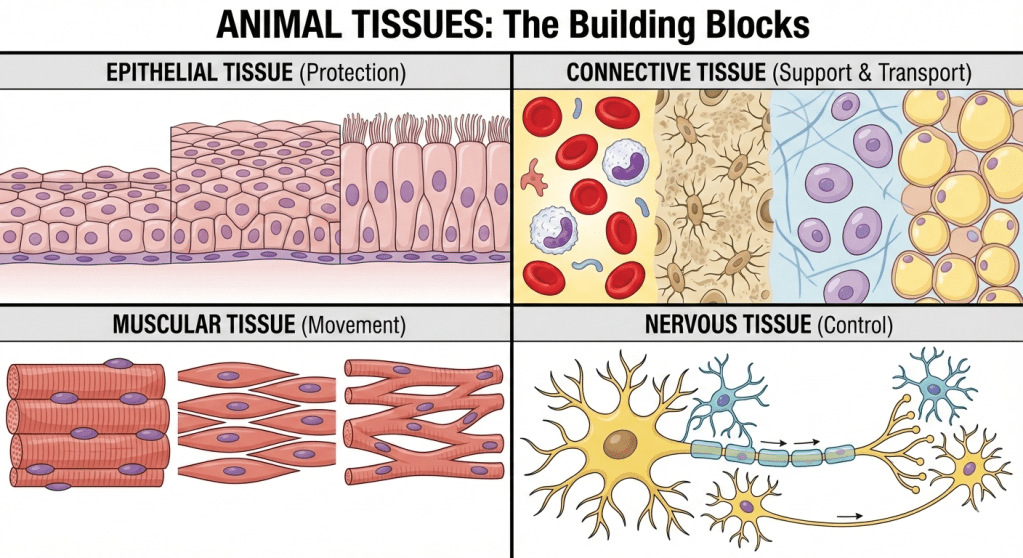
What are Animal Tissues?
Animal tissues are groups of similar cells that work together to perform specific functions like:
Protection
Movement
Transport
Coordination
Types of Animal Tissues
Animal Tissues
↓
| | | |
Epithelial Connective Muscular Nervous
1. EPITHELIAL TISSUE (Protective Tissue)
Covers body surfaces and organs
Examples:
- Skin
- Mouth lining
- Blood vessels
- Lung alveoli
- Kidney tubules
Features:
Cells tightly packed
Very little space between cells
Forms continuous sheet
Protects body
Helps in absorption & secretion
Types of Epithelial Tissue
Simple Squamous
- Thin & flat cells
- Found in lungs & blood vessels
- Helps in diffusion
Stratified Squamous
- Many layers
- Found in skin
- Protects from wear & tear
Columnar Epithelium
- Tall pillar-like cells
- Found in intestine
- Helps in absorption
Ciliated Columnar
- Has hair-like cilia
- Found in respiratory tract
- Moves mucus
Cuboidal Epithelium
- Cube-shaped cells
- Found in kidney tubules
- Provides support
Glandular Epithelium
- Secretes substances (sweat, saliva)
2. CONNECTIVE TISSUE (Connecting Tissue)
Connects, supports and transports
Cells are loosely arranged in a matrix.
Types of Connective Tissue
Blood
- Liquid tissue
- Transports oxygen, food, wastes
Contains:
- RBC → oxygen
- WBC → immunity
- Platelets → clotting
Bone
- Hard & strong
- Supports body
- Stores calcium
Cartilage
- Flexible
- Found in nose, ear
- Reduces friction
Ligament
- Connects bone to bone
- Elastic
Tendon
- Connects muscle to bone
- Very strong
Areolar Tissue
- Fills spaces
- Supports organs
- Helps repair
Adipose Tissue
- Stores fat
- Acts as insulation
- Found below skin
3. MUSCULAR TISSUE (Movement Tissue)
Made of muscle fibres.
Special proteins help muscles contract & relax.
Types of Muscles
Muscular Tissue
↓
————————-
| | |
Striated Smooth Cardiac
Striated (Skeletal / Voluntary)
- Attached to bones
- Under our control
- Long, cylindrical cells
- Many nuclei
Example: arm muscles
Smooth (Involuntary)
- Not under our control
- Found in stomach, intestine
- Spindle-shaped cells
- One nucleus
Cardiac (Heart Muscle)
- Found only in heart
- Rhythmic movement
- Branched cells
- One nucleus
4. NERVOUS TISSUE (Control Tissue)
Controls body activities.
Found in:
- Brain
- Spinal cord
- Nerves
Nerve Cell (Neuron Diagram)
Dendrites → Cell body → Axon
Parts:
Dendrites – receive message
Cell body – control centre
Axon – carries message
Function:
Carries nerve impulses very fast → helps in quick response.
Very Short Revision Chart
| Tissue | Function |
| Epithelial | Protection |
| Connective | Support & transport |
| Muscular | Movement |
| Nervous | Control & coordination |
Points
Blood is connective tissue
Muscles cause movement
Neurons carry impulses
Heart has cardiac muscles
Skin is stratified epithelium
 The Bio Brief
Leave a comment