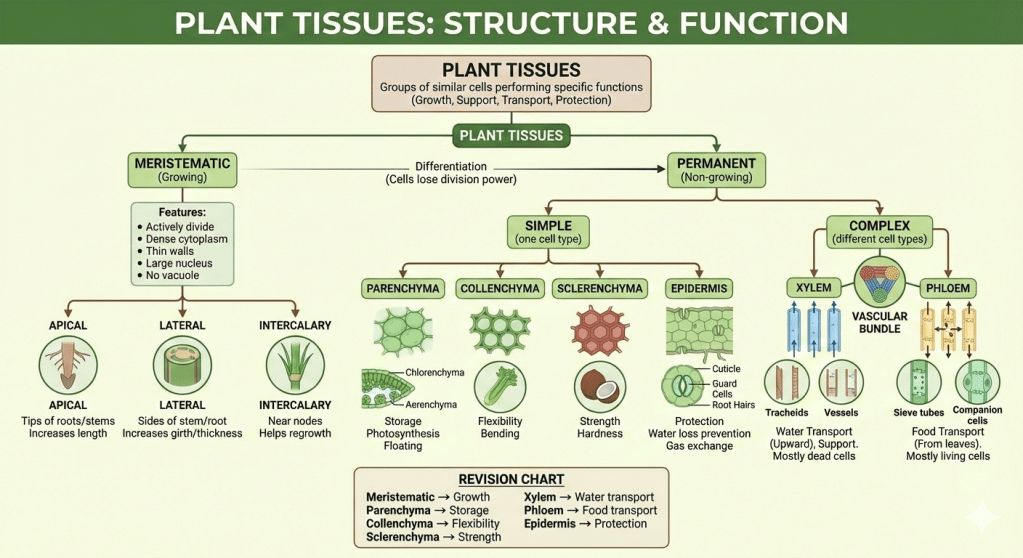
What are Plant Tissues?
Plant tissues are groups of similar cells that work together to perform specific functions like growth, support, transport, and protection.
Classification of Plant Tissues
Plant Tissues
↓
———————–
| |
Meristematic Permanent
(Growing) (Non-growing)
1. MERISTEMATIC TISSUE (Growing Tissue)
Function:
Helps in growth of plants
Location:
Only at special regions
Features:
- Cells actively divide
- Dense cytoplasm
- Thin cell walls
- Large nucleus
- No vacuole (because cells are busy dividing)
Types of Meristematic Tissue
Meristematic Tissue
↓
——————————–
| | |
Apical Lateral Intercalary
Apical Meristem
- Found at tips of roots & stems
- Increases length
Lateral Meristem (Cambium)
- Found on sides of stem/root
- Increases girth (thickness)
Intercalary Meristem
- Found near nodes (in grasses)
- Helps in regrowth
2. PERMANENT TISSUE
Formed from meristematic cells
Cells lose power of division
Process called Differentiation
Permanent Tissue Types
Permanent Tissue
↓
————————-
| |
Simple Complex
A. SIMPLE PERMANENT TISSUE
Made of one type of cells
Types:
1. Parenchyma
- Living cells
- Thin walls
- Large spaces between cells
- Stores food
Special types:
- Chlorenchyma → contains chlorophyll → photosynthesis
- Aerenchyma → air spaces → helps aquatic plants float
2.Collenchyma
- Living cells
- Provides flexibility
- Allows bending without breaking
- Found in leaf stalks
3. Sclerenchyma
- Dead cells
- Thick walls (lignin)
- Makes plant hard & strong
- Example: coconut husk
Epidermis (Protective Tissue)
Outermost layer
Protects plant
Prevents water loss
Features:
- Single layer of cells
- No intercellular spaces
- Covered with waxy cuticle
Stomata
Small pores on leaves:
Stomata
↓
Gas exchange
Transpiration
Surrounded by guard cells
Root Hairs
- Absorb water
- Increase surface area
Desert Plants
- Thick waxy cutin
- Reduces water loss
Cork (in old plants)
- Dead cells
- Contains suberin
- Prevents gas & water entry
B. COMPLEX PERMANENT TISSUE
Made of different types of cells working together
Two types:
Complex Tissue
↓
————-
| |
Xylem Phloem
Together they form vascular bundle
XYLEM (Water Transport)
Carries water & minerals upward.
Parts:
- Tracheids
- Vessels
- Xylem parenchyma
- Xylem fibres
Functions:
- Transport water
- Provide support
(Most xylem cells are dead)
PHLOEM (Food Transport)
Carries food from leaves to rest of plant.
Parts:
- Sieve tubes
- Companion cells
- Phloem parenchyma
- Phloem fibres
(Only fibres are dead)
Revision Chart
Meristematic → Growth
Parenchyma → Storage
Collenchyma → Flexibility
Sclerenchyma → Strength
Xylem → Water transport
Phloem → Food transport
Epidermis → Protection
 The Bio Brief
Leave a comment