What is Cell Division?
- Cell division is the process by which new cells are formed
- It is needed for:
- Growth
- Repair of damaged tissues
- Replacement of old and dead cells
- Formation of gametes (sperm & egg)
Old / Damaged Cells
↓
Cell Division
↓
New Cells
Types of Cell Division
There are two main types of cell division:
Cell Division
|
—————–
| |
Mitosis Meiosis
MITOSIS (Division for Growth)
Where does it occur?
- In body cells (somatic cells)
What happens?
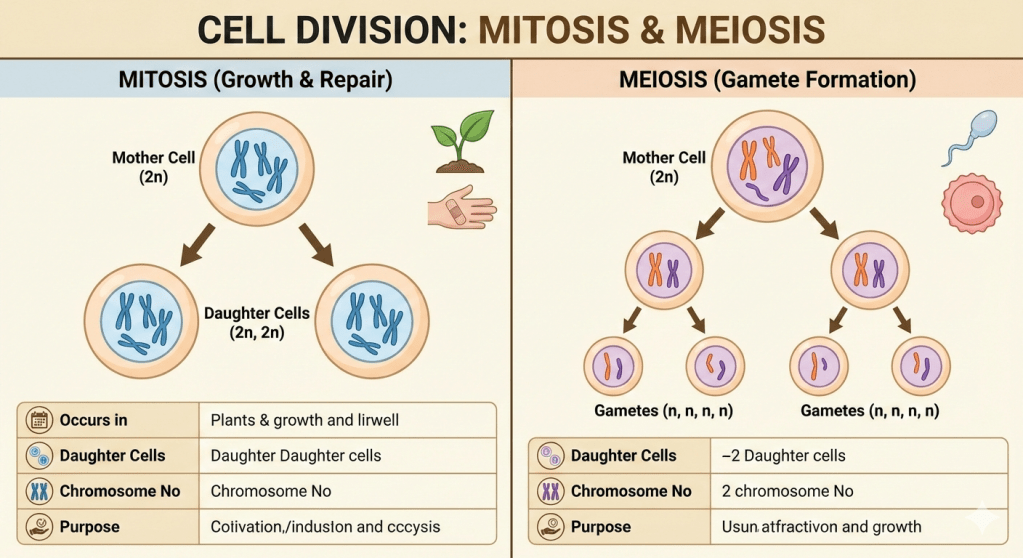
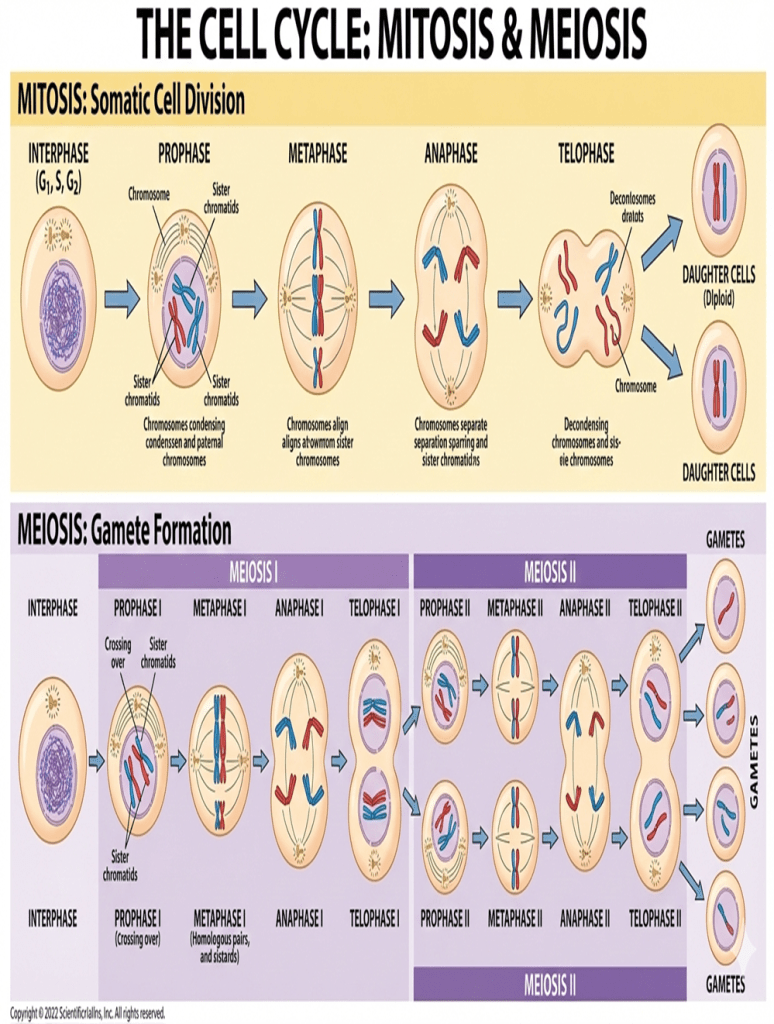
- One mother cell divides into two identical daughter cells
- Chromosome number remains same
Mother Cell (2n)
↓
Mitosis
↓
Two Daughter Cells (2n, 2n)
Importance of Mitosis
Growth of the body. Repair of tissues. Replacement of worn-out cells.
Example: Growth of skin cells, healing of wounds
MEIOSIS (Division for Reproduction)
Where does it occur?
- In reproductive organs
- Produces gametes (sperm & egg)
Special Features
- Occurs in two consecutive divisions
- One cell forms four daughter cells
- Daughter cells have half the chromosome number
Mother Cell (2n)
↓
Meiosis I
↓
Meiosis II
↓
Four Daughter Cells (n, n, n, n)
Importance of Meiosis
Formation of gametes. Maintains chromosome number after fertilisation. Creates variation in offspring
Why do daughter cells have half the chromosomes in meiosis?
Simple Explanation:
- During fertilisation:
- Sperm (n) + Egg (n)
- Forms a zygote (2n)
Sperm (n) + Egg (n)
↓
Zygote (2n)
If gametes had full chromosomes, chromosome number would double in every generation. Meiosis prevents this problem
COMPARISON: MITOSIS vs MEIOSIS
| Feature | Mitosis | Meiosis |
| Occurs in | Body cells | Reproductive cells |
| No. of divisions | One | Two |
| Daughter cells | Two | Four |
| Chromosome number | Same as parent | Half of parent |
| Purpose | Growth & repair | Sexual reproduction |
KEY POINTS TO REMEMBER
Mitosis = growth & repair. Meiosis = gamete formation. Mitosis → 2 identical cells
Meiosis → 4 different cells. Meiosis keeps chromosome number constant in species
 The Bio Brief
Leave a comment