What are Cell Organelles?
- Cells have small structures inside them called organelles
- Each organelle has a specific function
- Eukaryotic cells (plant & animal cells) have membrane-bound organelles
- Prokaryotic cells do not
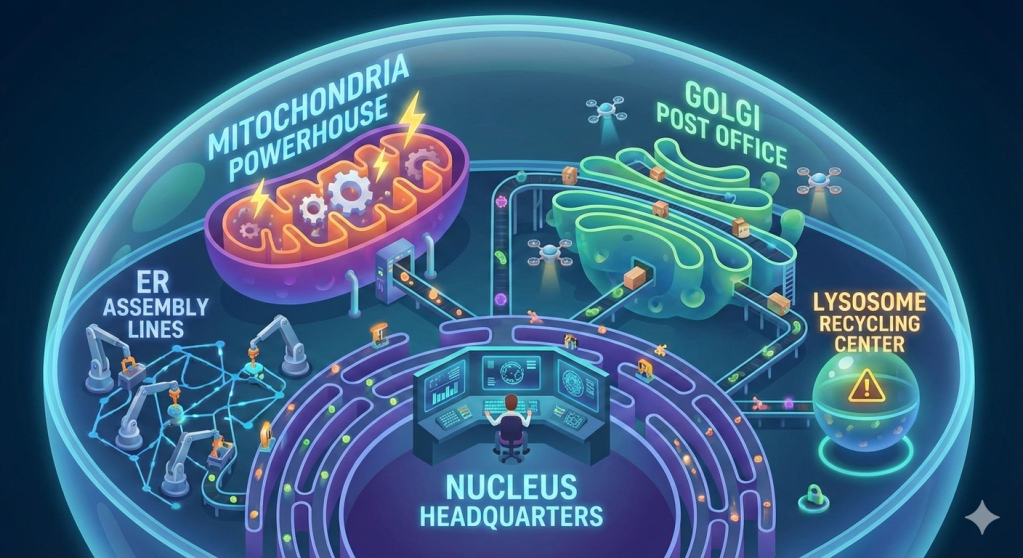
Think of a cell like a factory, and organelles are different departments doing different jobs.
ENDOPLASMIC RETICULUM (ER)
What is ER?
- A network of membranes
- Looks like tubes and flattened sacs
- Helps in transport and production
Types of ER
Endoplasmic Reticulum
|
———————
| |
Rough ER (RER) Smooth ER (SER)
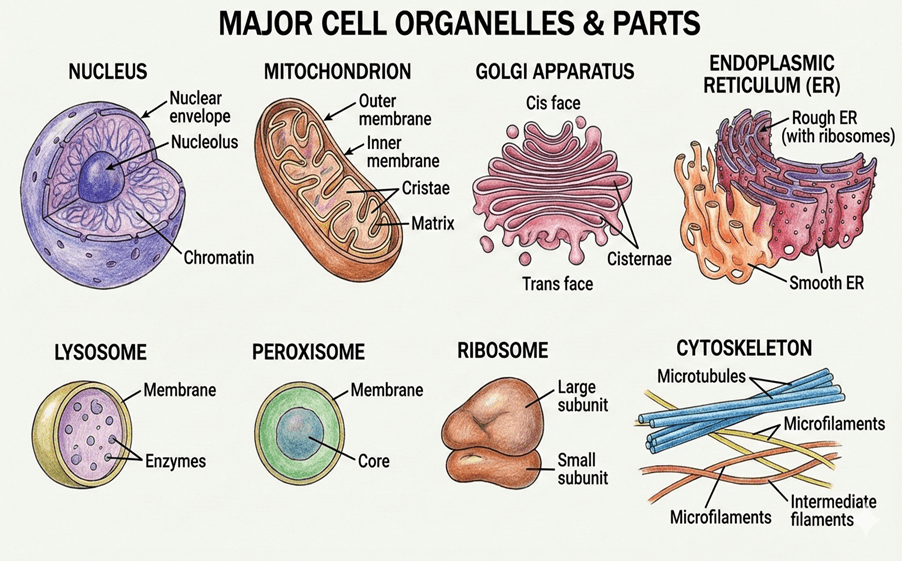
Rough ER (RER)
- Has ribosomes attached
- Makes proteins
- Proteins are sent to different parts of the cell
Smooth ER (SER)
- No ribosomes
- Makes fats (lipids)
- Helps in detoxification (especially in liver cells)
Functions of ER
- Protein & lipid synthesis
- Transport inside cell
- Helps in membrane formation (membrane biogenesis)
GOLGI APPARATUS (POST OFFICE OF CELL)
Structure
- Stack of flattened membrane sacs called cisterns
ER → Golgi Apparatus → Vesicles → Destination
Functions
- Modifies proteins & lipids
- Packages them into vesicles
- Sends them inside or outside the cell
- Helps in lysosome formation
Analogy: ER = factory → Golgi = post office → vesicles = parcels
LYSOSOMES (SUICIDE BAGS)
Structure
- Small membrane-bound sacs
- Filled with digestive enzymes
Functions
- Digests:
- Waste material
- Old organelles
- Bacteria & foreign particles
Waste / Bacteria
↓
Lysosome
↓
Broken into simple substances
If cell is damaged → lysosome bursts → cell digests itself Hence called “suicide bags”
MITOCHONDRIA (POWERHOUSE)
Structure
- Double membrane
- Inner membrane has folds called cristae
Outer Membrane
Inner
Folded → Cristae
Functions
- Produces ATP (energy)
- ATP = energy currency of the cell
Special Features
- Has its own DNA
- Has ribosomes
- Can make some of its own proteins
PLASTIDS (ONLY IN PLANT CELLS)
Types of Plastids
Plastids
|
———————
| |
Chloroplasts Leucoplasts
Chloroplasts
- Green plastids
- Contain chlorophyll
- Site of photosynthesis
Sunlight + CO₂ + Water
↓
Chloroplast
↓
Food + O₂
Leucoplasts
- Colourless
- Storage of:
- Starch
- Oils
- Proteins
Special Point: Plastids have their own DNA & ribosomes (like mitochondria)
VACUOLES (STORAGE TANK)
Structure
- Membrane-bound sacs
- Size varies
In Plant Cells
- Very large central vacuole
- Filled with cell sap
- Maintains:
- Turgidity
- Rigidity
In Animal Cells
- Small vacuoles
In Amoeba
- Food vacuole stores food
- Contractile vacuole removes excess water
QUICK REVISION TABLE
| Organelle | Main Function |
| ER | Protein & lipid synthesis |
| Golgi | Packaging & transport |
| Lysosome | Digestion & waste removal |
| Mitochondria | Energy (ATP) production |
| Plastids | Photosynthesis & storage |
| Vacuole | Storage & rigidity |
FINAL POINT:
Cell = basic structural & functional unit of life. Organelles work together to:
- Respire
- Get nutrition
- Remove waste
- Make proteins
Differences Between Plant Cell and Animal Cell
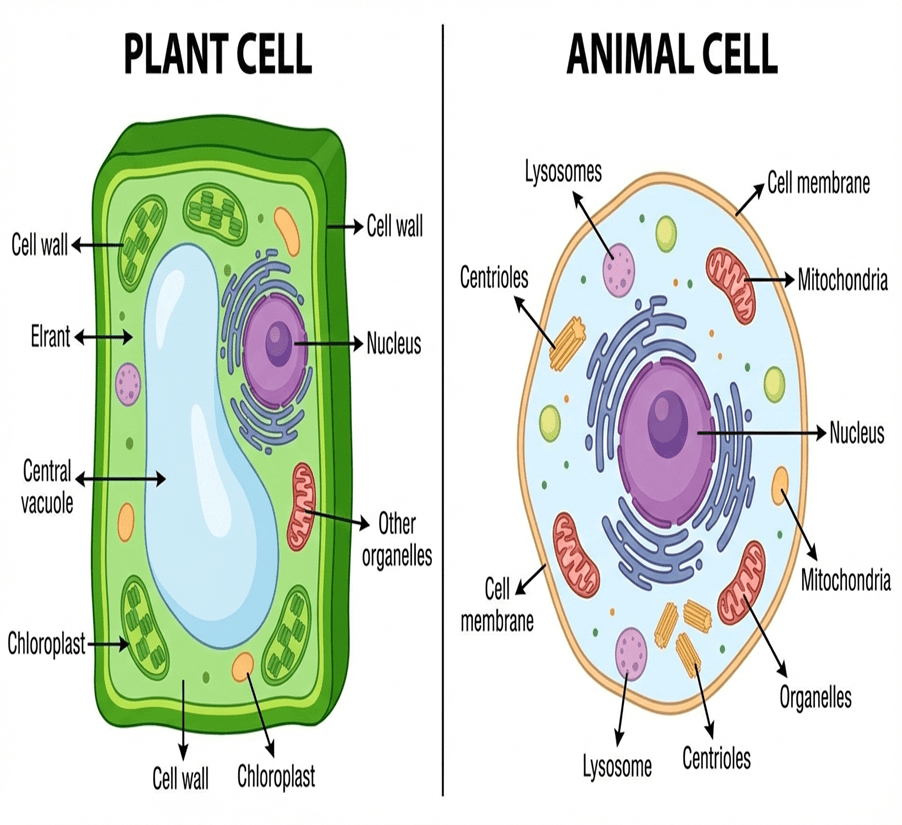
| Feature | Plant Cell | Animal Cell |
| Cell wall | Present (made of cellulose) | Absent |
| Shape | Usually rectangular / fixed | Usually round or irregular |
| Chloroplast | Present (photosynthesis) | Absent |
| Plastids | Present | Absent |
| Vacuole | Large central vacuole | Small or temporary vacuoles |
| Mode of nutrition | Autotrophic (makes its own food) | Heterotrophic |
| Mitochondria | Present | Present |
| Lysosomes | Rare | Common |
| Centrosome | Absent | Present |
| Storage material | Starch | Glycogen |
 The Bio Brief
Leave a comment