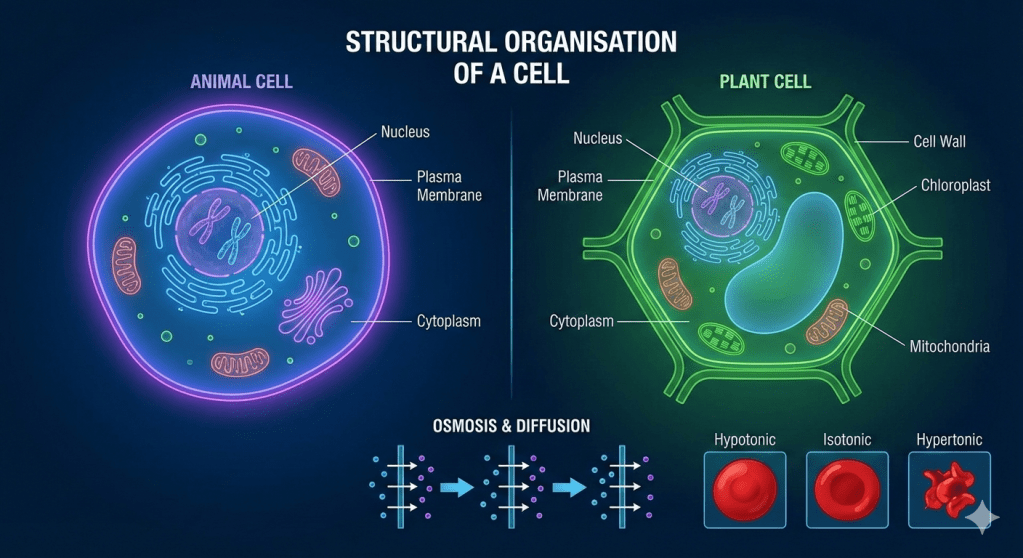
Structural Organisation of a Cell
When we observe a cell under a microscope, we usually see three main parts:
Basic Parts of a Cell
- Plasma membrane (Cell membrane)
- Cytoplasm
- Nucleus
All activities of the cell and interaction with the environment happen because of these parts.
Flow Chart: Basic Structure of a Cell
Cell
↓
Plasma Membrane
Cytoplasm
Nucleus
Plasma Membrane (Cell Membrane)
What is Plasma Membrane?
- It is the outermost covering of the cell.
- It separates the cell contents from the external environment.
- It is thin, flexible, and living.
Functions of Plasma Membrane
- Controls entry and exit of substances
- Protects the cell
- Helps the cell interact with surroundings
Because it allows some substances to pass and blocks others, it is called a
Selectively Permeable Membrane
Movement of Substances Across Cell Membrane
1. Diffusion
- Movement of substances from high concentration → low concentration
- Does not require energy
Examples:
- Oxygen (O₂) enters the cell
- Carbon dioxide (CO₂) moves out of the cell
Flow Chart: Diffusion
High Concentration
↓
Low Concentration
↓
Diffusion (No Energy)
2. Osmosis
- Movement of water molecules through a selectively permeable membrane
- Water moves toward higher solute concentration
Osmosis is a special type of diffusion
Definition:
Osmosis is the diffusion of water across a selectively permeable membrane from a region of higher water concentration to lower water concentration.
Effect of Different Solutions on Cells (Osmosis)
1. Hypotonic Solution
- Outside solution is dilute
- More water enters the cell
- Cell swells
2. Isotonic Solution
- Same concentration inside and outside
- No net movement of water
- Cell remains same size
3. Hypertonic Solution
- Outside solution is concentrated
- Water leaves the cell
- Cell shrinks
Table: Effect of Solutions
| Solution Type | Water Movement | Effect on Cell |
| Hypotonic | Enters cell | Cell swells |
| Isotonic | Equal in & out | No change |
| Hypertonic | Leaves cell | Cell shrinks |
Flow Chart: Osmosis Effect
Type of Solution
↓
Water Movement
↓
Change in Cell Size
Try them out to learn:
Osmosis Experiment (Egg)
Egg in Pure Water
- Egg swells
- Water enters by osmosis
Egg in Salt Solution
- Egg shrinks
- Water moves out
Raisins / Apricot Experiment
- In plain water → swell
- In salt/sugar solution → shrink
These experiments prove osmosis.
Importance of Osmosis
- Helps plants absorb water through roots
- Helps maintain cell size
- Important for freshwater organisms
Transport Using Energy
- Some substances need energy to enter or leave the cell
- This is called active transport
Structure of Plasma Membrane
- Made of lipids and proteins
- Flexible in nature
- Seen clearly only with an electron microscope
Endocytosis
- Cell membrane can engulf food
- Process is called endocytosis
- Seen in Amoeba
Flow Chart: Endocytosis
Food Outside Cell
↓
Cell Membrane Engulfs Food
↓
Food Inside Cell
Electron Microscope (Short Note)
- An electron microscope uses a beam of electrons instead of light.
- It has very high magnification and high resolving power.
- It helps us see:
- Cell membrane structure
- Cell organelles clearly
- Invented in the 1940s.
Why important? It helped scientists understand the detailed structure of cells.
Cell Wall (Only in Plant Cells)
What is Cell Wall?
- A rigid outer layer present outside the plasma membrane
- Found in plants, fungi, and bacteria
- Absent in animal cells
Composition of Cell Wall
- Mainly made of cellulose
- Cellulose provides strength and support to plants
Functions of Cell Wall
- Gives shape to the cell
- Protects the cell
- Prevents cell from bursting in hypotonic solution
Plasmolysis
- When a plant cell loses water by osmosis
- The cell content shrinks away from the cell wall
- This process is called plasmolysis
Flow Chart: Plasmolysis
Plant Cell in Concentrated Solution
↓
Water Moves Out (Osmosis)
↓
Cell Shrinks
↓
Plasmolysis
Importance of Cell Wall
- Allows plant cells to survive in hypotonic solutions
- Prevents bursting by balancing pressure
Nucleus
What is Nucleus?
- A dark, round or oval structure
- Usually present near the centre of the cell
- Called the control centre of the cell
Structure of Nucleus
- Surrounded by double-layered nuclear membrane
- Nuclear membrane has pores
- Pores allow movement of materials between nucleus and cytoplasm
Chromosomes & DNA
- Nucleus contains chromosomes
- Chromosomes are made of:
- DNA
- Proteins
DNA & Genes
- DNA stores hereditary information
- Functional parts of DNA are called genes
- Genes control traits passed from parents to offspring
Flow Chart: Genetic Material
Nucleus
↓
Chromosomes
↓
DNA
↓
Genes
Chromatin Material
- In non-dividing cells, DNA is present as chromatin
- Appears as thread-like structures
- During cell division → chromatin forms chromosomes
Functions of Nucleus
- Controls cell activities
- Helps in cell division
- Directs growth and development
Prokaryotes vs Eukaryotes
| Feature | Prokaryotes | Eukaryotes |
| Nuclear membrane | Absent | Present |
| Nucleus | Nucleoid | True nucleus |
| Cell organelles | Absent | Present |
| Examples | Bacteria | Plants, animals |
Special Case: Prokaryotes
- DNA present in nucleoid
- Chlorophyll (if present) is in membranous vesicles
- No plastids
Cytoplasm
What is Cytoplasm?
- Jelly-like fluid inside the cell
- Found between:
- Cell membrane
- Nucleus
Features of Cytoplasm
- Lightly stained region
- Contains cell organelles
- Site of many chemical reactions
Cell Organelles in Cytoplasm
- Mitochondria
- Ribosomes
- Endoplasmic reticulum
- Golgi apparatus
- Plastids (in plants)
Flow Chart: Cytoplasm Role
Cytoplasm
↓
Contains Organelles
↓
Organelles Perform Functions
↓
Cell Survives & Works
Cytoplasm in Prokaryotes vs Eukaryotes
- Prokaryotes: no membrane-bound organelles
- Eukaryotes: membrane-bound organelles present
Viruses – Special Case
- Viruses lack membranes
- Do not show life outside host
- Become active only inside a living cell.
 The Bio Brief
Leave a comment