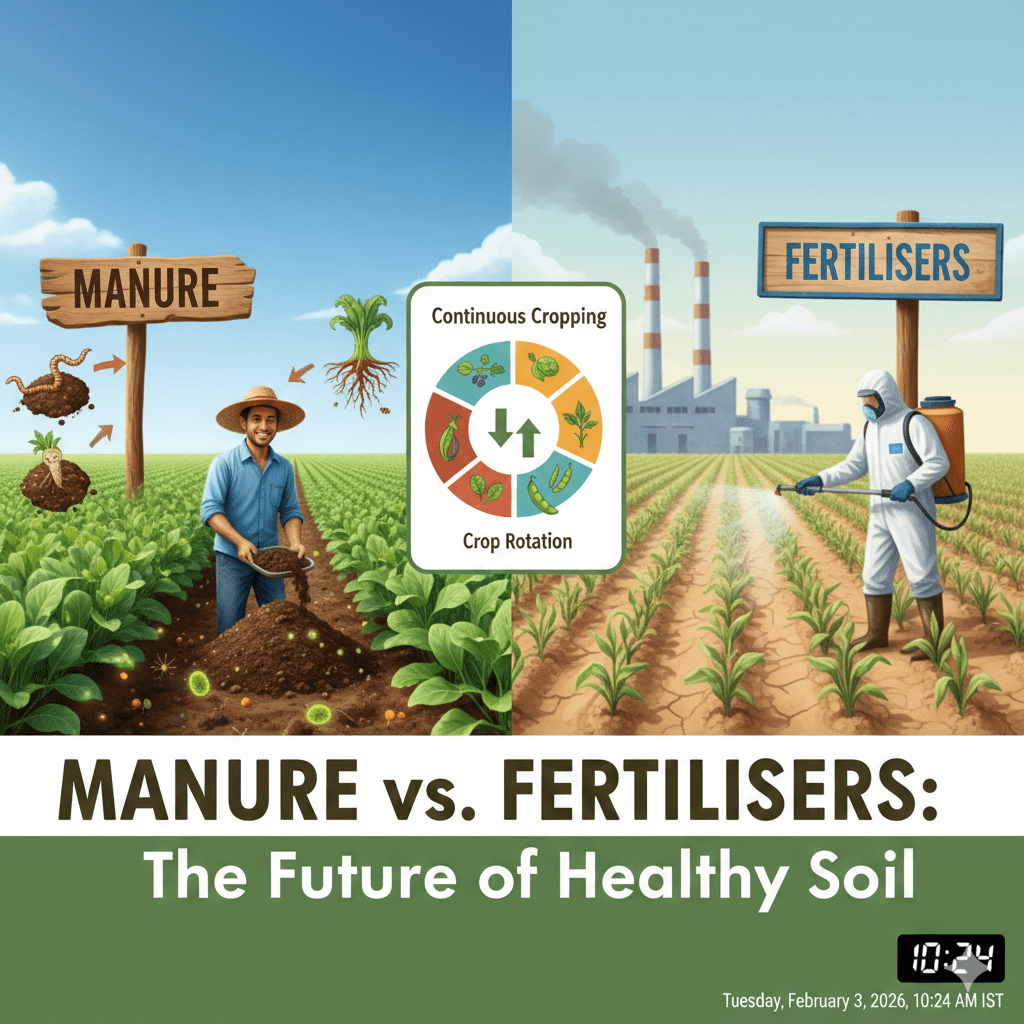
The substances added to the soil to provide nutrients for healthy plant growth are called manure and fertilisers.
Plants need nutrients such as nitrogen, phosphorus, and potassium for proper growth. When farmers grow crops repeatedly in the same field without leaving it empty (fallow), the nutrients in the soil get depleted. As a result, plants become weak and yield decreases. To restore soil nutrients, farmers add manure or fertilisers. This process is called manuring.
Continuous cropping
↓
Loss of soil nutrients
↓
Weak plants & low yield
↓
Manuring needed
Manure
Manure is an organic substance obtained from the decomposition of plant and animal wastes.
Preparation of Manure
- Plant and animal waste is collected in pits
- Microorganisms decompose the waste
- The decomposed matter is used as manure
Plant & animal waste
↓
Decomposition by microbes
↓
Organic manure
Example: Vermicomposting (using earthworms)
Advantages of Manure
- Improves soil texture
- Increases water-holding capacity
- Makes soil porous (better air exchange)
- Increases friendly microorganisms
- Replenishes soil nutrients naturally
Fertilisers
Fertilisers are chemical substances rich in specific nutrients. They are manufactured in factories and provide nutrients quickly to plants.
Examples of Fertilisers
- Urea
- Ammonium sulphate
- Super phosphate
- Potash
- NPK (Nitrogen, Phosphorus, Potassium)
Effects of Fertilisers
- Increase crop yield (wheat, rice, maize)
- Excessive use:
- Reduces soil fertility
- Causes water pollution
- Kills useful soil organisms
Crop Rotation
Another method of restoring soil nutrients is crop rotation.
- Different crops are grown alternately in the same field
- Leguminous plants (peas, gram, beans) are grown to increase nitrogen in soil
Leguminous crop
↓
Rhizobium bacteria
↓
Nitrogen fixation
↓
Improved soil fertility
Rhizobium bacteria live in the root nodules of leguminous plants and fix atmospheric nitrogen.
Differences Between Manure and Fertilisers
| Manure | Fertilisers |
| Organic substance | Chemical substance |
| Made from plant and animal waste | Manufactured in factories |
| Improves soil structure | Does not improve soil structure |
| Releases nutrients slowly | Provides nutrients quickly |
| Increases microbes in soil | Reduces useful microbes if overused |
| Environment-friendly | Causes soil and water pollution |
| Increases water-holding capacity | Does not increase water-holding capacity |
| Long-term benefit | Short-term benefit |
Why Manure is Better Than Fertilisers
- Improves soil fertility naturally
- Maintains ecological balance
- Prevents soil degradation
- Supports sustainable agriculture
Summary
Healthy soil
↓
Use manure + limited fertilisers
↓
Proper crop rotation
↓
Better yield & soil fertility
 The Bio Brief
Leave a comment