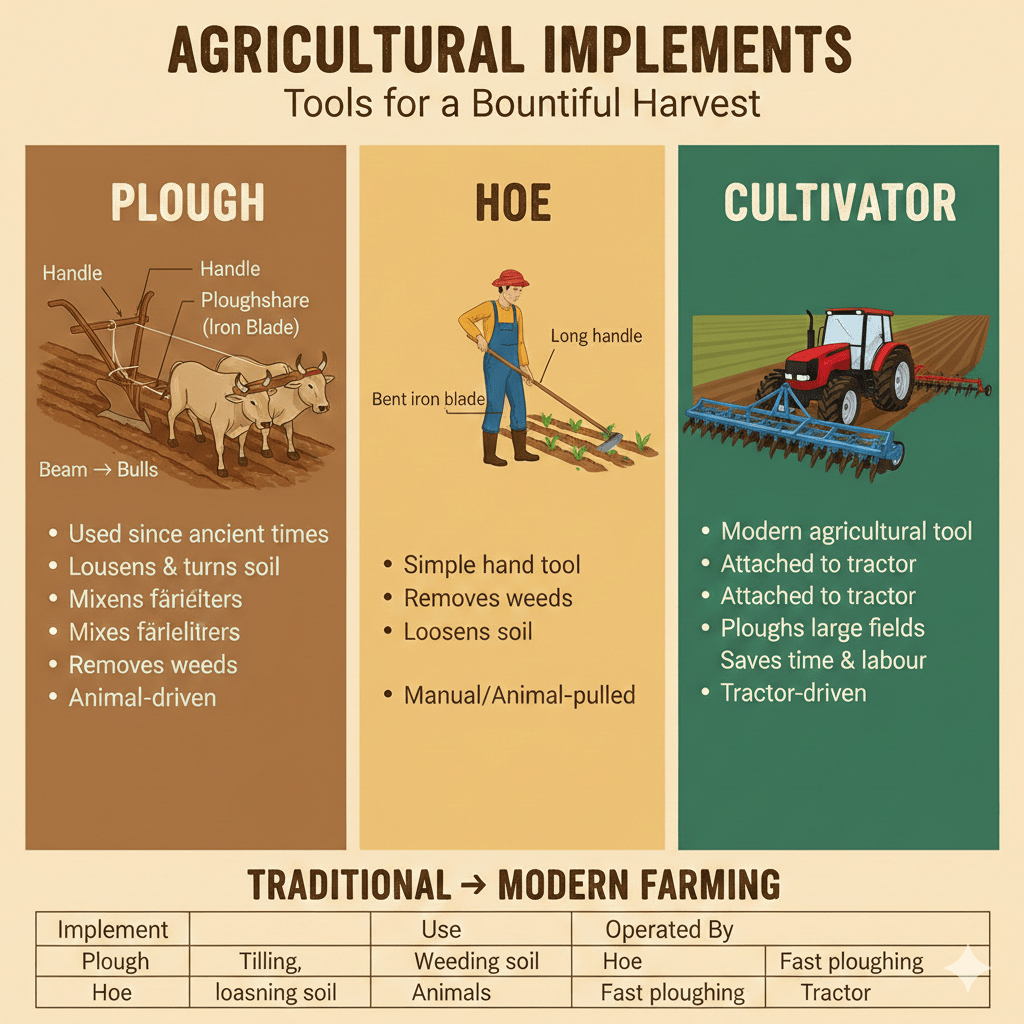
Before sowing seeds, the soil must be loosened and soil clumps broken to get a better crop yield. This work is done using agricultural implements (tools).
Main Agricultural Implements
Agricultural Implements
↓
Plough Hoe Cultivator
1. Plough
- Used since ancient times
- Main functions:
- Loosening and turning the soil
- Mixing fertilisers or manure with soil
- Removing weeds
- Usually made of wood, but modern ploughs are made of iron
- Drawn by a pair of bulls or other animals like horses or camels
Parts of a Plough
- Ploughshaft: Long wooden part
- Handle: Used by the farmer to control the plough
- Ploughshare: Strong triangular iron blade that cuts the soil
- Beam: Attached to the necks of bulls
One farmer and a pair of bulls can easily operate a plough.
Wooden ploughs are now being replaced by iron ploughs.
Diagram idea:
Handle
|
Ploughshaft
|
Ploughshare (Iron blade)
|
Beam → Bulls
2. Hoe
- A simple hand tool
- Used for:
- Removing weeds
- Loosening the soil
- Has a long rod made of wood or iron
- A broad, bent iron blade is fixed at one end
- Usually pulled by animals
Diagram idea:
Long handle
|
Bent iron blade
3. Cultivator
- A modern agricultural tool
- Attached to a tractor
- Used for ploughing large fields
- Advantages:
- Saves time
- Reduces labour
- Increases efficiency
Traditional Plough → Animal-driven
Cultivator → Tractor-driven
Summary Table
| Implement | Use | Operated by |
| Plough | Tilling, turning soil | Animals |
| Hoe | Weeding, loosening soil | Animals |
| Cultivator | Fast ploughing of fields | Tractor |
 The Bio Brief
Leave a comment