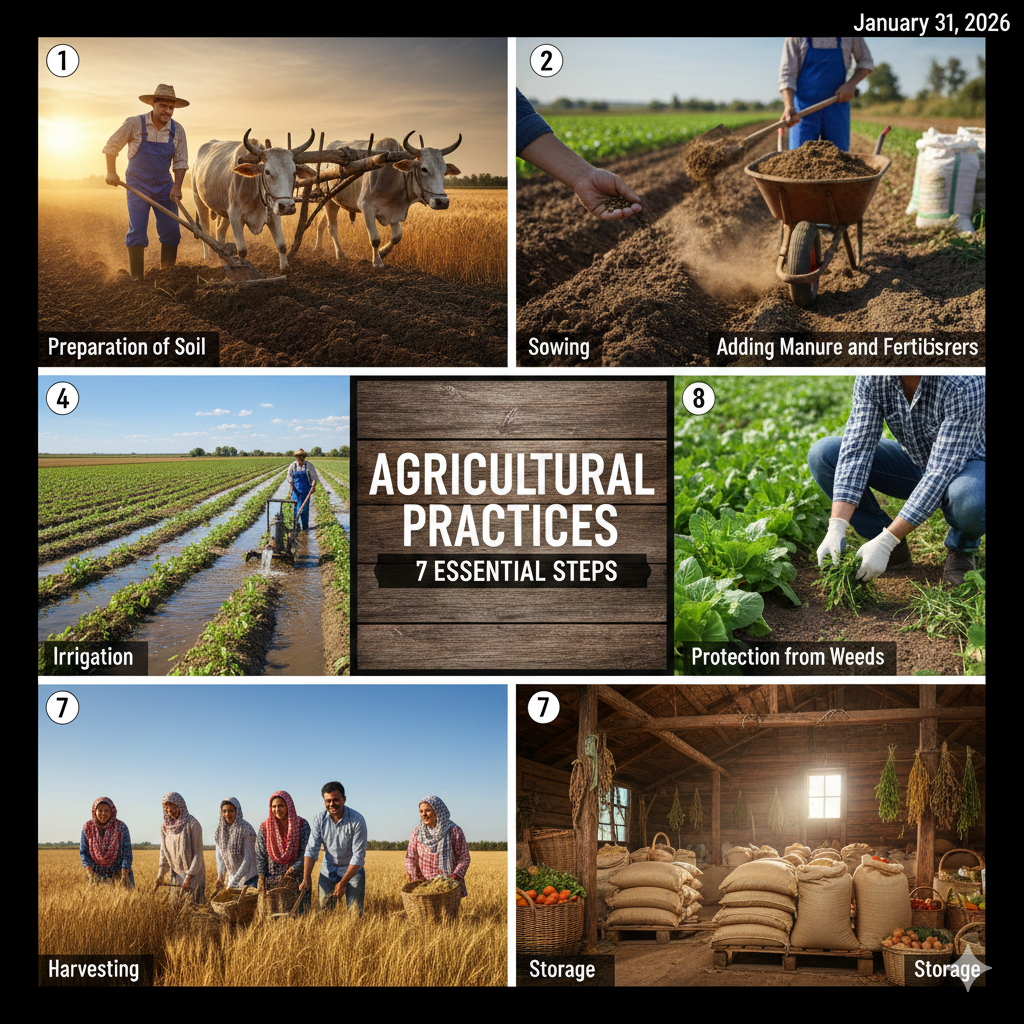
Crop production involves a series of activities carried out by farmers over a period of time.
These activities are similar to the tasks performed by a gardener or by us when we grow plants at home. Such activities are called agricultural practices.
Main Agricultural Practices
- Preparation of soil
- Sowing
- Adding manure and fertilisers
- Irrigation
- Protection from weeds
- Harvesting
- Storage
Preparation of Soil
Preparation of soil is the first and most important step in crop production. It involves loosening and turning the soil so that plants can grow well.
Why is soil loosened and turned?
- Loosening the soil allows roots to grow deep into the soil.
- Roots can breathe easily because loose soil contains more air.
- It promotes the growth of earthworms and microorganisms, which are helpful to farmers.
- These organisms further loosen the soil and add humus, which increases soil fertility.
Soil contains minerals, water, air, and living organisms.
Dead plants and animals decompose in the soil and release nutrients.
Only the top layer of soil supports plant growth by turning the soil, nutrient-rich soil comes to the surface, making nutrients available to plants.
Tilling or Ploughing
- The process of loosening and turning the soil is called tilling or ploughing.
- It is done using a plough, which may be made of wood or iron.
- If the soil is very dry, it is watered before ploughing.
After ploughing, large lumps of soil called crumbs are formed. These must be broken to make the field smooth.
Levelling of Soil
- Levelling the field is important for uniform sowing and proper irrigation.
- It is done using a leveller.
Sometimes, manure is added before tilling so that it mixes well with the soil.
Before sowing seeds, the soil is made moist to support germination.
 The Bio Brief
Leave a comment