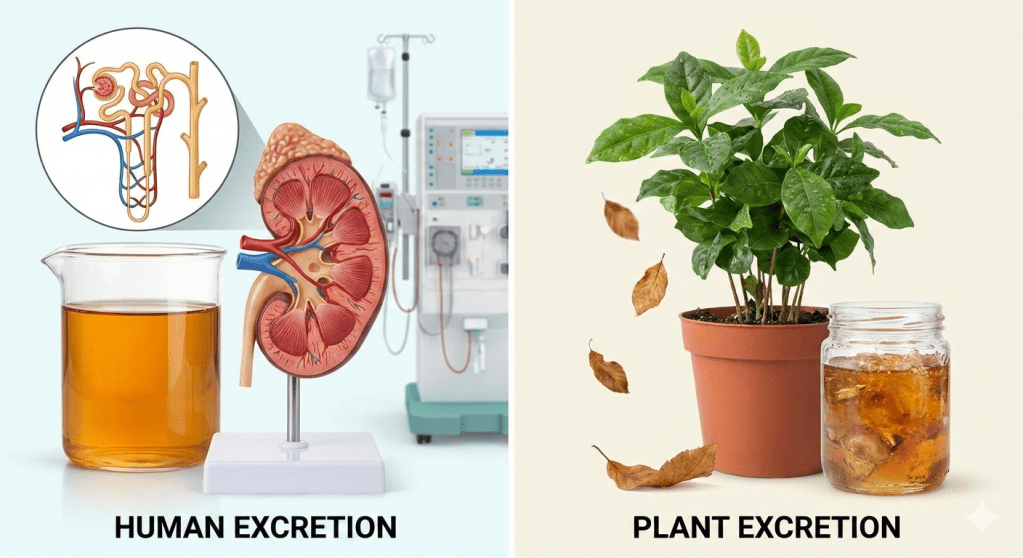
What is Excretion?
- Excretion is the process of removing harmful metabolic wastes from the body.
- These wastes are mainly nitrogenous wastes like:
- Urea
- Uric acid
- Excretion is important to keep the body healthy.
Excretion in Different Organisms
- Unicellular
→ Remove wastes by simple diffusion through body surface. - Multicellular
→ Use specialised organs for excretion.
EXCRETION IN HUMAN BEINGS
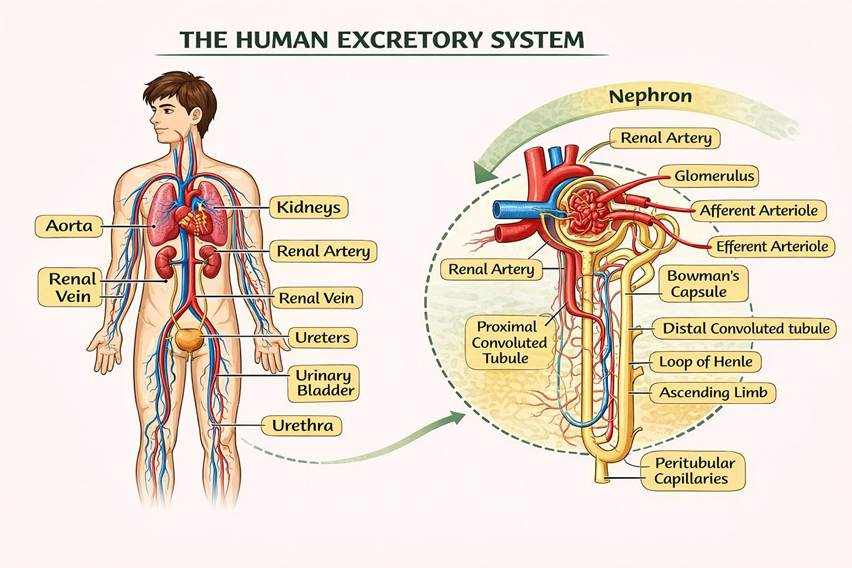
Human Excretory System (Parts)
Kidneys → Ureters → Urinary Bladder → Urethra
Functions of Parts:
- Kidneys: Filter blood and form urine
- Ureters: Carry urine to bladder
- Urinary bladder: Stores urine
- Urethra: Releases urine outside the body
How is Urine Formed?
Basic Unit of Kidney → Nephron
Each kidney has millions of nephrons
Structure of Nephron (Simplified)
Blood Capillaries
↓
Bowman’s Capsule
↓
Kidney Tubule
Steps of Urine Formation (Flow Chart)
Blood enters kidney
↓
Filtration in Bowman’s capsule
↓
Useful substances reabsorbed
↓
Waste + extra water forms urine
Important Points:
- Filtered substances: Urea, salts, water
- Reabsorbed substances:
- Glucose
- Amino acids
- Most water
- Amount of water reabsorbed depends on:
- Body’s water level
- Amount of waste present
Storage and Removal of Urine
Kidney → Ureter → Urinary Bladder → Urethra
- Urinary bladder is muscular
- Controlled by nervous system
- Humans can control urination
ARTIFICIAL KIDNEY (HEMODIALYSIS)
When is it needed?
- Kidney failure due to:
- Infection
- Injury
- Poor blood supply
How Artificial Kidney Works (Dialysis)
Process (Flow Chart):
Blood taken from patient
↓
Passed through semi-permeable tubes
↓
Waste diffuses into dialysing fluid
↓
Clean blood returned to body
Key Points:
- Dialysing fluid:
- Same osmotic pressure as blood
- No nitrogenous waste
- No reabsorption occurs (unlike real kidneys)
- Healthy kidney:
- Filters ~180 L/day
- Excretes only 1–2 L urine/day
EXCRETION IN PLANTS
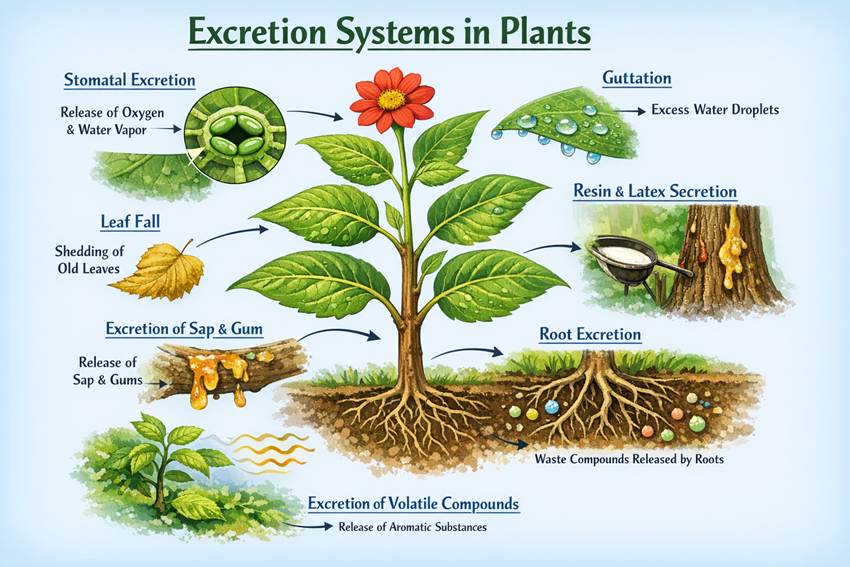
Plants do not have special excretory organs.
Methods Used by Plants:
Gaseous Wastes
- Oxygen (from photosynthesis)
- Carbon dioxide
- Removed through stomata
Excess Water
- Removed by Transpiration
Other Waste Products
- Stored in:
- Vacuoles
- Leaves (which fall off)
- Stored as:
- Resins
- Gums (in old xylem)
- Some wastes are:
- Released into the soil
Summary Table:
| Humans | Plants |
| Kidneys remove waste | No special organs |
| Urine formed | Waste stored or released |
| Dialysis possible | Leaves fall off |
 The Bio Brief
Leave a comment