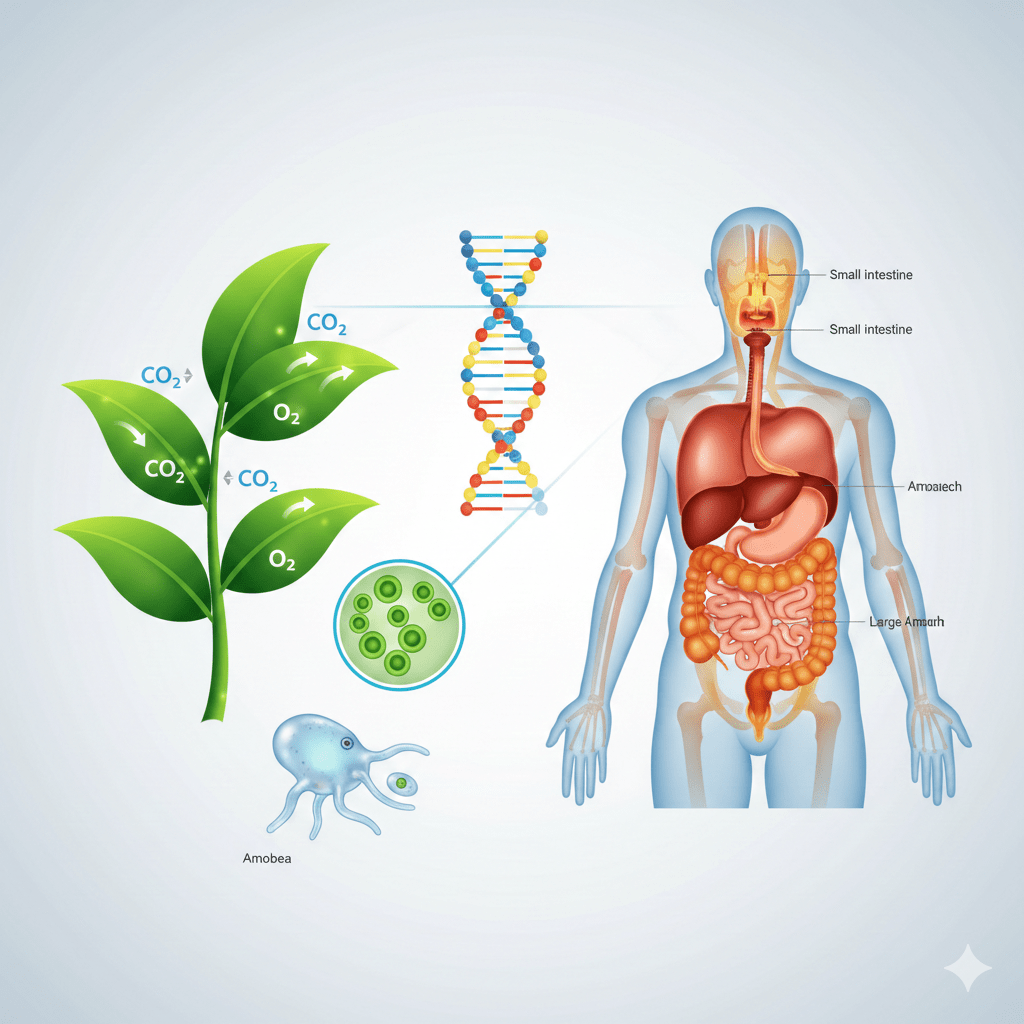
All living organisms need energy to perform various activities. Even when the body is at rest, energy is required to carry out important life processes such as growth, repair, and maintenance. This energy is obtained from food, which is taken from outside the body
Definition:
Nutrition is the process by which living organisms obtain food and utilize it to get energy, grow, repair body tissues, and maintain life processes.
Why Is Nutrition Necessary?
• Provides energy for all life processes
• Required even when the body is at rest
• Helps in growth, development, repair, and synthesis of substances
How Do Living Things Get Their Food?
All organisms require energy and materials, but they obtain them in different ways. Some organisms prepare their own food using simple inorganic substances like carbon dioxide and water. These organisms are called autotrophs.
Autotrophic Nutrition
• Organisms prepare their own food
• Use carbon dioxide, water, sunlight, and chlorophyll
• Food is usually prepared in the form of glucose
Examples: Green plants, algae, some bacteria
Other organisms depend on complex food materials. These materials must be broken down into simpler substances before use. This process is carried out with the help of enzymes. Such organisms are called heterotrophs.
Heterotrophic Nutrition
• Organisms depend on other organisms for food
• Food is complex and must be broken down by enzymes
Examples: Animals, fungi, humans
Autotrophic Nutrition:
Photosynthesis:
Photo means light
Synthesis means to prepare
What is Photosynthesis?
Photosynthesis is the process by which green plants (autotrophs) make their own food using:
- Carbon dioxide (CO₂)
- Water (H₂O)
- Sunlight
- Chlorophyll
The food prepared is carbohydrates (glucose), which provide energy to the plant.
Why is Photosynthesis Important?
- Provides food to plants
- Stores energy
- Releases oxygen (O₂) needed by living organisms
- Forms the base of the food chain
Raw Materials Required for Photosynthesis:
| Raw Material | Source |
| Carbon dioxide | Air (through stomata) |
| Water | Soil (absorbed by roots) |
| Sunlight | Sun |
| Chlorophyll | Chloroplasts in green leaves |
Stored Energy in Plants:
- Extra carbohydrates are stored as starch
- Starch acts as the energy reserve of plants
- Similar to glycogen storage in humans
Steps of Photosynthesis:
Flowchart: Events in Photosynthesis
Sunlight
↓
Absorption of light energy by chlorophyll
↓
Conversion of light energy to chemical energy
↓
Splitting of water into Hydrogen + Oxygen
↓
Carbon dioxide reduced to Carbohydrates (Glucose)
Three Main Events:
- Absorption of light energy by chlorophyll
- Splitting of water into hydrogen and oxygen
- Reduction of carbon dioxide to carbohydrates
These steps do not always occur immediately one after the other
Special Case: – Desert Plants
- Take in carbon dioxide at night
- Store it as an intermediate compound
- Use sunlight during the day to complete photosynthesis
Role of Chlorophyll:
- Chlorophyll is a green pigment
- Present in chloroplasts
- Absorbs sunlight
- Essential for photosynthesis
How Does CO₂ Enter the Plant?
Stomata
- Tiny pores on leaves
- Allow exchange of gases
Guard Cells Control Stomata
| Condition | Guard Cells | Stomata |
| Water enters | Swollen | Open |
| Water leaves | Shrunken | Closed |
Stomata close when CO₂ is not needed to prevent water loss
Other Nutrients Needed by Plants:
| Nutrient | Importance |
| Nitrogen | Protein synthesis |
| Phosphorus | Energy transfer |
| Iron | Chlorophyll formation |
| Magnesium | Component of chlorophyll |
Nitrogen Absorption:
- Taken as nitrates or nitrites
- Or converted from atmospheric nitrogen by bacteria
Overall Photosynthesis Equation:
Carbon dioxide + Water
↓ (Sunlight + Chlorophyll)
Carbohydrates + Oxygen
6CO₂ + 6H₂O → C₆H₁₂O₆ + 6O₂
Heterotrophic Nutrition
What is Heterotrophic Nutrition?
Heterotrophic nutrition is the mode of nutrition in which organisms cannot make their own food and depend on other organisms for food.
Animals, fungi, and many microorganisms are heterotrophs.
Types of Heterotrophic Nutrition:
(A) Saprophytic Nutrition
- Organisms feed on dead and decaying matter
- Food is digested outside the body
- Nutrients are then absorbed
Examples:
Fungi – bread mould, yeast, mushroom
(B) Parasitic Nutrition
- Organism lives on or inside another organism (host)
- Gets food from host without killing it
- Harms the host
Examples:
Cuscuta(Amar-bel)
Ticks,lice,leeches
Tapeworm
(C) Holozoic Nutrition
- Food is taken inside the body
- Digested inside
- Common in animals and humans
Examples:
Amoeba, Human beings
How Do Organisms Obtain Their Nutrition?
Nutrition in Unicellular Organisms
Nutrition in Amoeba
Steps:
- Ingestion – Food taken in by pseudopodia
- Digestion – Food broken down in food vacuole
- Absorption – Nutrients diffuse into cytoplasm
- Assimilation – Used for energy and growth
- Egestion – Undigested food thrown out
Flowchart: Nutrition in Amoeba
Food captured by pseudopodia
↓
Food vacuole formed
↓
Digestion inside vacuole
↓
Absorption into cytoplasm
↓
Undigested food expelled
Nutrition in Paramecium
- Has a definite shape
- Covered with cilia
- Cilia help move food to a specific spot (oral groove)
Nutrition in Human Beings (Holozoic Nutrition)
Alimentary Canal
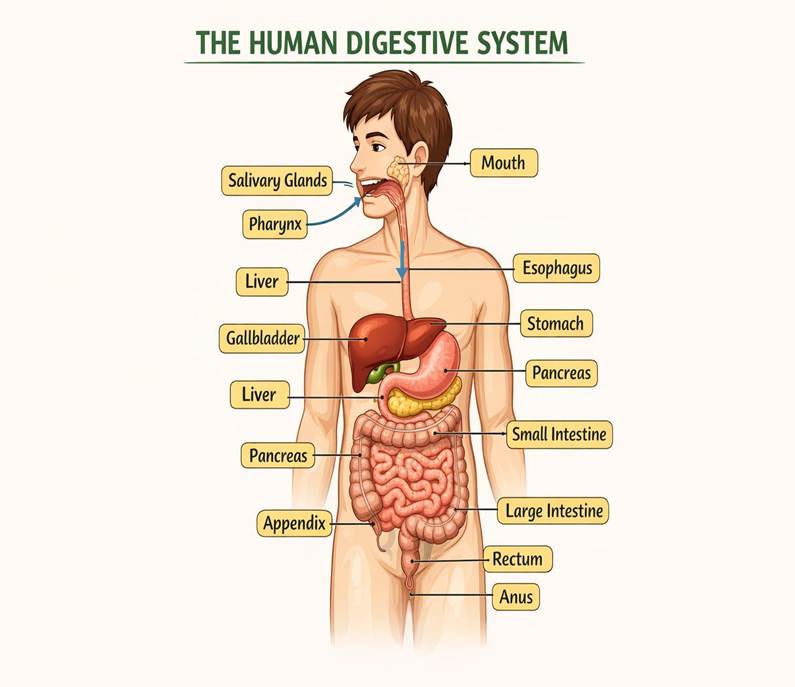
A long tube from mouth to anus
Flowchart: Human Digestive System
Mouth
↓
Oesophagus
↓
Stomach
↓
Small Intestine
↓
Large Intestine
↓
Anus
Digestion in Different Parts of the Alimentary Canal
(A) Mouth
- Food is chewed by teeth
- Mixed with saliva
- Saliva contains salivary amylase
- Starch → Simple sugars
(B) Oesophagus
- Food pushed by peristaltic movements
- No digestion occurs
(C) Stomach
- Food mixed with gastric juice
- Gastric glands release:
- Hydrochloric acid (HCl) – kills germs & activates pepsin
- Pepsin – digests proteins
- Mucus – protects stomach lining
Excess acid causes acidity
(D) Small Intestine (Main Site of Digestion)
- Long and highly coiled
- Receives:
- Bile juice (from liver)
- Pancreatic juice (from pancreas)
- Intestinal juice
Functions:
- Complete digestion of:
- Carbohydrates → Glucose
- Proteins → Amino acids
- Fats → Fatty acids + Glycerol
Role of Bile Juice
- Makes food alkaline
- Breaks fats into small droplets (emulsification)
(E) Absorption of Food
- Small intestine has villi
- Villi increase surface area
- Nutrients absorbed into blood
(F) Large Intestine
- Absorbs water
- Forms faeces
(G) Anus
- Undigested waste removed
- Controlled by anal sphincter
Difference in Digestive System
| Animal | Food Type | Small Intestine |
| Herbivores (cow) | Plant food | Long |
| Carnivores (lion) | Meat | Short |
Dental Caries (Tooth Decay)
Causes:
- Bacteria act on sugars
- Produce acid
- Acid damages enamel
Process:
Sugary food
↓
Bacteria produce acid
↓
Enamel weakens
↓
Tooth decay
Prevention:
- Brush teeth regularly
- Remove dental plaque
- Maintain oral hygiene

 The Bio Brief
Leave a comment