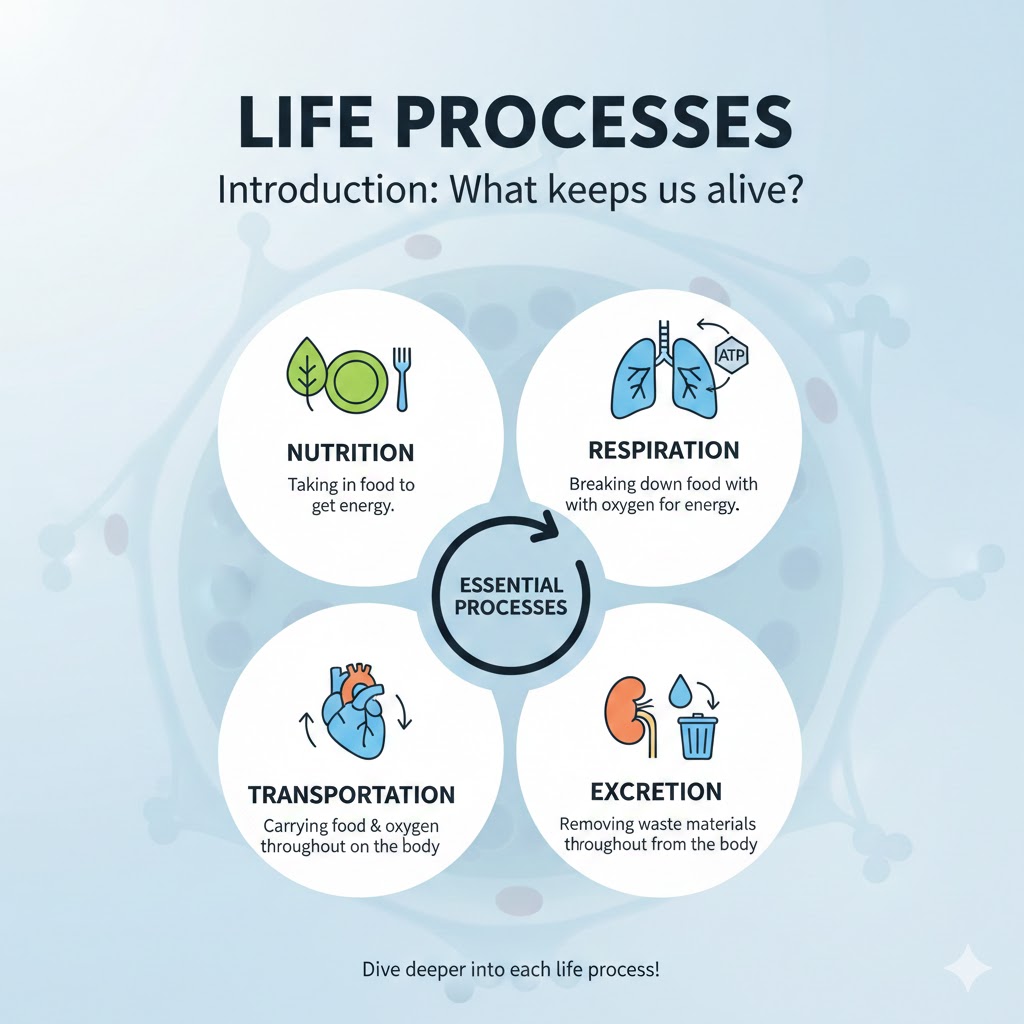
Introduction:
Generally, we can identify an organism as living when it shows movement. However, even when an organism is at rest, it is still considered alive because several important processes continue inside its body. These processes help maintain life. The essential processes required to keep an organism alive are called life processes.
What are life processes?
Generally, many life processes take place continuously inside our body. To carry out these processes, the body needs energy, which it gets from food. The process of taking in food and using it to obtain energy is called nutrition, and it is essential for all living organisms.
The food we eat must be broken down into simpler substances so that the body can use it. This involves several chemical reactions that require oxygen. The process of taking in oxygen and releasing energy from food is called respiration. In single-celled organisms, respiration occurs by simple diffusion.
During these chemical reactions, harmful waste materials are produced. To keep the body healthy, these wastes must be removed. The removal of toxic and unwanted substances from the body is called excretion.
Food and oxygen are taken in by different organs, so they need to be carried to all parts of the body. The process that helps in the transport of nutrients and oxygen throughout the body is known as transportation.
Now let’s dive deeper into each life process.
 The Bio Brief
Leave a comment